Product Updates
How Wireless MPG Controls Benefit Your Shop Floor
AMAG Team8 min read
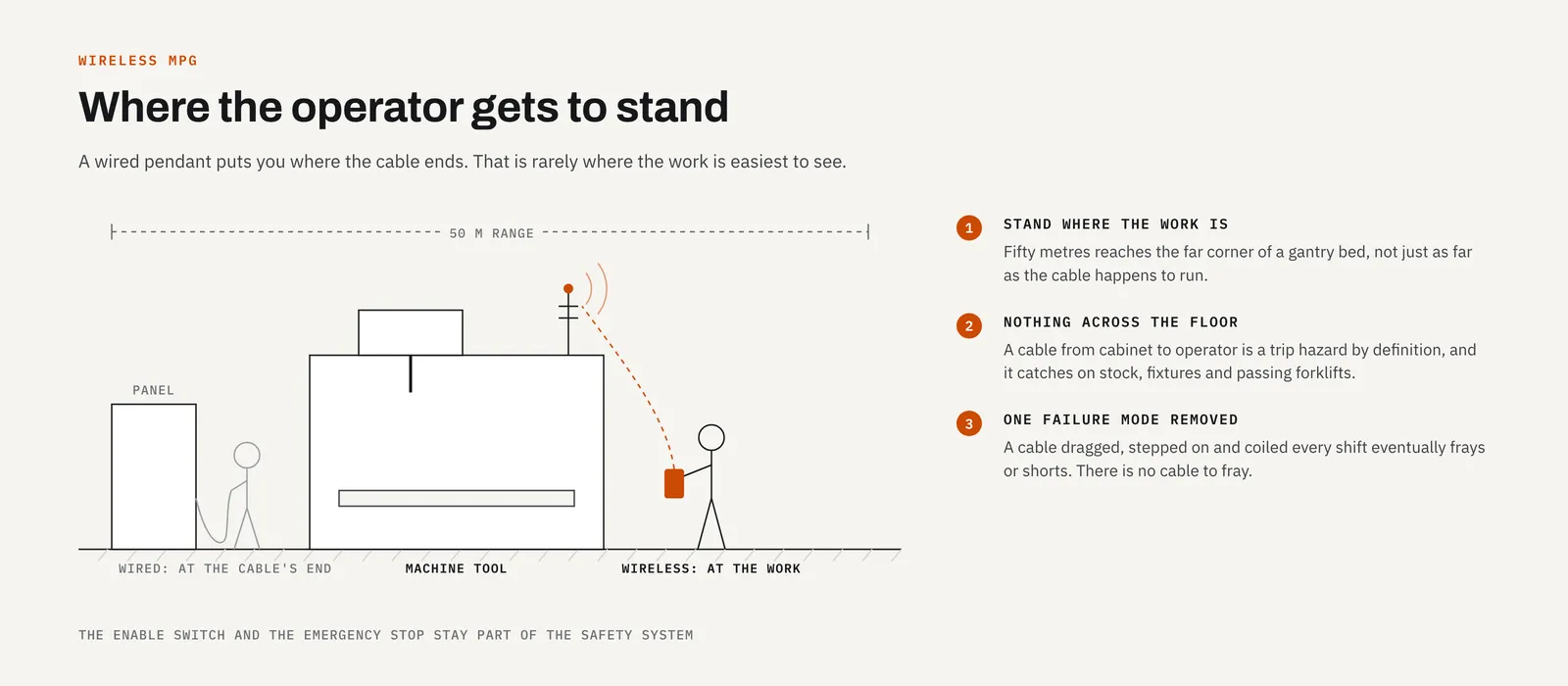
The evolution from wired to wireless manual pulse generators (MPG) represents a significant leap forward in CNC machine control. Let's explore why manufacturers are making the switch to wireless technology, what actually changes on the shop floor, and where the real gains come from rather than the marketing gloss.
What is an MPG?
A Manual Pulse Generator is the handwheel on a CNC pendant: a detented rotary encoder that lets an operator jog an axis in small, precise increments, with a step multiplier (commonly x1/x10/x100) setting how far each click moves the machine. Traditional wired MPGs have been the industry standard for decades, and the wheel itself hasn't changed: what's changed is how the pendant talks to the machine. A wireless MPG digitises the wheel counts and switch states at the pendant and sends them to a receiver at the electrical cabinet, which reproduces those signals exactly as a wired handwheel would. To the CNC control, the two look identical. We cover the mechanism in detail in how a manual pulse generator works, and weigh the two against each other, including where wired still wins, in wireless MPG vs. wired handwheel.
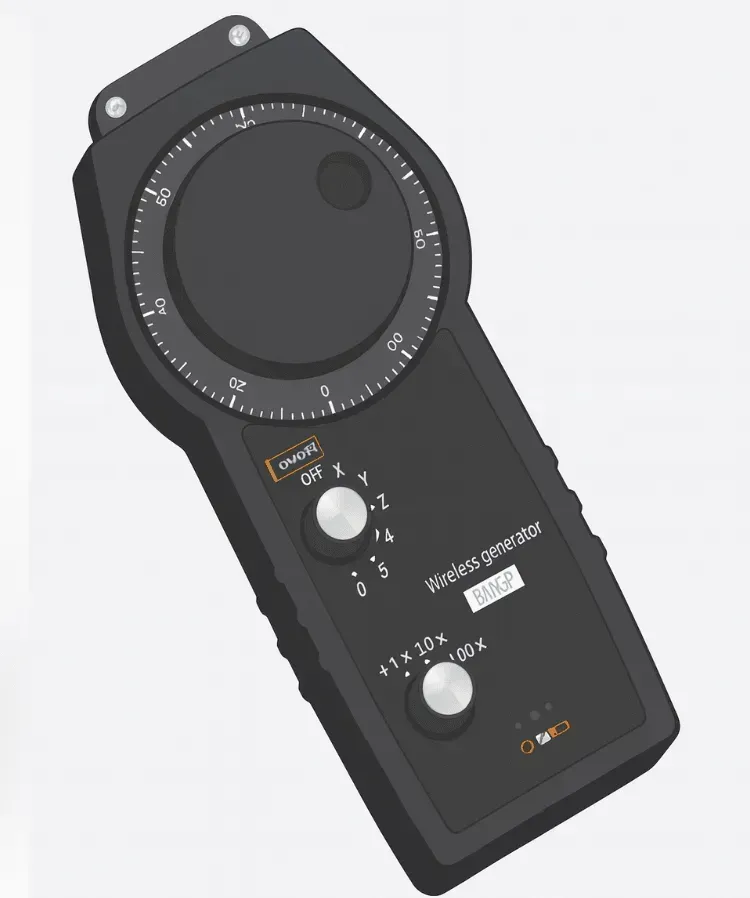 The pendant itself: the same handwheel and switches as a wired unit, with a receiver at the cabinet standing in for the cable.
The Advantages of Wireless MPG Controls
1. Enhanced Operator Mobility
With a 50-metre wireless range, operators can position themselves anywhere on the shop floor for the best viewing angle on a setup, instead of working from wherever the cable happens to reach. That matters most during the operations where the wheel actually gets used: bringing a cutter down towards a reference surface, sweeping in a vice, splitting an edge on a dial indicator. Being able to stand at the vice or the far corner of the table, rather than tethered to the panel, is the difference between watching the work directly and watching it through a machine frame.
2. Improved Safety
- Eliminate Trip Hazards: A cable running from the control cabinet to wherever the operator is standing is a tripping hazard by definition, and it gets worse as the shop gets busier around the machine.
- Better Ergonomics: Operators aren't forced into whatever position lets the cable reach; they can hold the pendant naturally and stand where the work is actually visible.
- Cleaner Shop Floor: No cable snaking across the floor near a machine in motion, and no cable to catch on stock, fixtures, or a passing forklift.
Both the pendant's enable (deadman) switch and its emergency stop remain fully part of the safety system on a properly designed wireless unit: going wireless doesn't mean going without those functions. A design that behaves conservatively will command no motion at all without a valid operator input, which is the standard to hold any wireless pendant to.
3. Increased Productivity
- Faster Setup: No time spent running a cable, coiling it back up, or working around where it's routed.
- More Efficient Machining: Standing where the work is best seen means fewer walk-backs to the panel to check something the operator could have watched directly.
- Reduced Downtime from Cable Wear: A cable that's dragged, stepped on, and coiled every shift eventually frays or shorts; removing it removes that failure mode entirely.
4. Compatibility with Major Controllers
Our wireless MPG systems are compatible with:
- Siemens
- Fagor
- Mitsubishi Electric
- Fanuc
- Heidenhain
That compatibility is real engineering, not a checkbox: a properly integrated wireless pendant answers the same four configuration questions on every controller family (direction, axis assignment, step increment, and permission to move), just through each vendor's own menus and parameter names. The specifics of connecting to each platform are covered in wireless MPG integration across controller families.
5. Professional Features
- 5-Axis Control: Full control over every machine axis, including rotary axes on machining centres where a wired pendant with limited selector positions runs out of reach.
- 50-Metre Range: Coverage across large shop floors, verified with a walk-test at commissioning rather than assumed from the spec sheet.
- 1-Year Warranty: Standard from date of invoice against manufacturing defects.
Making the Switch
Migrating from wired to wireless MPG follows a predictable sequence:
- Assessment: Determine your coverage area and which controller(s) you're integrating with.
- Selection: Confirm compatibility with your specific CNC controller and software version before ordering.
- Installation: Mount the receiver and antenna correctly. Receiver placement is the single most consequential decision in the whole installation: mounting it inside a grounded steel electrical cabinet turns the enclosure into a Faraday cage and throttles range before any shop-floor interference even enters the picture. The antenna belongs outside the cabinet, elevated, with as clear a line of sight as possible to where operators actually stand.
- Integration: Wire the receiver into the control per your controller's parameter or machine-data documentation, and verify all four configuration items: direction, axis, increment, and the enable/e-stop safety chain.
- Acceptance Testing: Walk the entire working area with the pendant live, with the shop running normally (drives on, other machines cutting), to map coverage and find any dead spots before they surface mid-setup.
Full detail on receiver placement, antenna positioning, and the acceptance-test procedure is in keeping wireless controls reliable on a noisy shop floor.
Real-World Impact
The productivity case for wireless MPG isn't a marketing number: it follows directly from the mechanism. Every minute an operator would otherwise spend managing a cable, walking back to the panel to check something they could have watched directly, or working around a coiled cord underfoot is a minute the wheel isn't doing its job. Shops that make the switch typically notice it first during setup and fixture work, where the operator's position relative to the workpiece changes constantly and a cable is the single biggest constraint on where they can stand.
Which Shops Feel the Difference Most
The gain scales with how far an operator has to travel from the control panel to reach the work, and how often they need to reposition during a job. Three situations stand out:
Large-format CNC routers. A router bed can run several metres long, and a wired pendant's cable simply can't reach every corner of a large sheet without being dragged across the table or the material itself. A wireless pendant with a 50-metre range covers the whole bed from any position.
Multi-axis machining centres with rotary tables. Once a fourth or fifth axis is in play, the operator often needs to check clearance from an angle the panel doesn't offer: behind the rotary table, at the tailstock, alongside a tombstone fixture. A 5-axis wireless MPG reaches every one of those positions without the selector-position limits a compact wired pendant runs into.
High-mix job shops running frequent setups. Where production shops set up once and run for hours, job shops re-fixture constantly, and every setup means walking the part, checking clearances, and jogging in from a new angle. The cumulative time saved by not managing a cable adds up fastest here, simply because setup happens more often.
Shops running long, unattended production cycles on a handful of parts see the least difference, since the pendant gets used rarely once a job is dialled in. That's a legitimate reason to weigh the upgrade against your actual setup frequency rather than assuming it's universally worth it.
The Future of Shop Floor Control
As wireless technology continues to mature on the shop floor, the trend is towards tighter integration rather than new gimmicks: better documented controller integration paths, more robust RF hygiene practices as a standard part of installation (not an afterthought), and pendants that report their own health (battery state, signal quality) rather than leaving operators to guess. None of that changes what the wheel does; it changes how invisible the wireless link becomes once it's set up correctly.
Conclusion
Wireless MPG controls represent more than just a convenience upgrade. They remove the one physical constraint (the cable) that has always limited where an operator can stand relative to the work, without giving up anything on the safety functions that make a handwheel trustworthy in the first place. At AMAG, we're committed to providing wireless control solutions built around that principle: same trusted mechanism, no cable, full safety chain intact.
Ready to upgrade your shop floor? View our wireless MPG controls or contact us today to learn more.
Related articles
Technical Guides
CNC Lubrication System Layout: Where the Pump, Lines and Distributors Go
Sizing tells you what to buy; layout decides if you can maintain it. Pump placement, trunk and branch routing, and where distributors must sit.
Buying Guide
Wireless MPG Pendant vs. Wired Handwheel: Which Belongs on Your Machine
Same encoder, same signals to the control. A wireless pendant and a wired handwheel differ in reach, failure mode and habit, and wired sometimes wins.
Technical Guides
When a Centralised Grease System Can Run NLGI 2
NLGI 2 belongs on a 30 MPa progressive circuit, not a GM or 35-type reservoir. The three grease pressure classes decide the grade, and what mixing them costs.