Technical Guides
When a Centralised Grease System Can Run NLGI 2
AMAG Team9 min read
The last time we wrote about grease grade, the sentence was blunt: centralised systems run NLGI 000 and 00, and putting cartridge-thick NLGI 2 into one is how a maintenance department spends an afternoon opening packed lines. That sentence is true for the circuit it was written about: a GM pump feeding volumetric distributors through small-bore tube at a few tens of kilograms per square centimetre.
It is not true of every centralised grease system we sell. A wind-turbine yaw bearing, a roll neck, or a press column can be on a 30 MPa progressive circuit whose pump is rated for NLGI 2, and whose blocks are built to push it. Loading 000 into that system because a blog post said "centralised means semi-fluid" is the same class of mistake as the original one, just in the other direction.
The deciding number is not "centralised or not." It is the pressure class of the pump.
Three classes, three grades
The grease catalogue splits the range by the output of the drive source. Everything downstream (distributor family, hose, and the stiffest grade the circuit will move) follows that one number. Mixing across the classes is the most common specification error we see.
Low / volumetric grease, below 10 MPa. The AP is the pump this class is set to: 3.5–3.8 MPa off a vehicle's own DC 12 V or 24 V supply, 260 ml/min, NLGI 000# to 0# only, for chassis and mobile-plant circuits. The AD lives here too (2.5–5.5 MPa, NLGI 0# / 00# / 000#), as do the grease builds of the RH3 (G and GH suffixes, 20–50 kgf/cm², 00# / 000#). Semi-fluid grease is not a compromise on this hardware. The passages are cut for it. A stiffer grade will stall the 35-type piston. The block's own caution says so.
Middle, roughly 8–16 MPa on the named pump, though the catalogue's own "middle pressure" tag also covers the GM. The PJ sits at the low end, 8.0 MPa, 20 ml/min, NLGI 000# to 1#, while the NKGH runs 10 MPa by hand. Both still need a take-off so the 35-type can refill; the extra pressure over the low class buys longer runs and NLGI 0# or 1#, not a cartridge of NLGI 2. The GM sits with them by AMAG's own grease catalogue, which calls it "the standard middle-pressure pump for plastic and engineering machinery," even though its own number is lower: 3.5 MPa rated (35 kgf/cm²), 5.0 MPa maximum, NLGI 000# or 00# only, feeding a 35-type whose grease action window is 30–40 kgf/cm². The class here is a catalogue position, not a strict floor every pump in it has to individually clear.
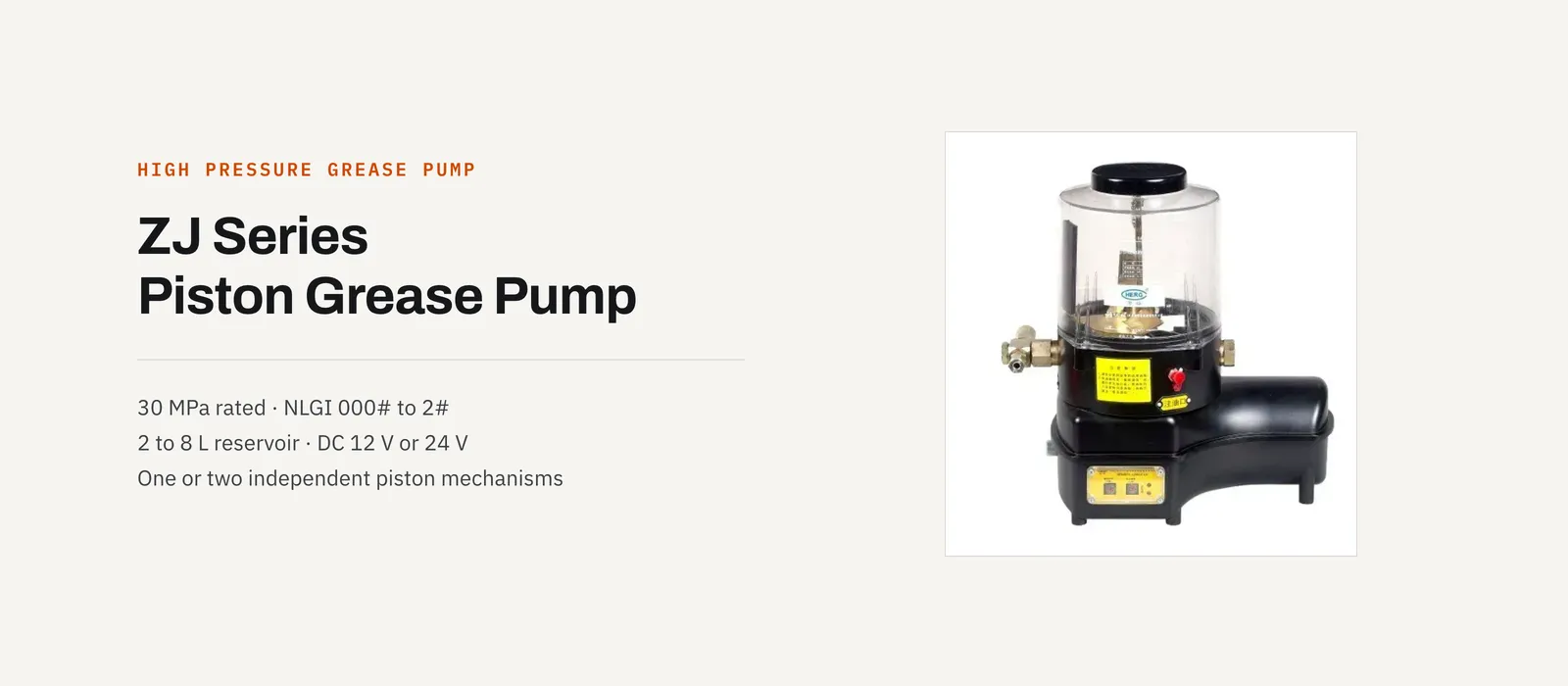
High / progressive, roughly 15–32 MPa. Again a circuit-class band, not a per-part minimum. The ZJ raises grease to 30 MPa, safety valve preset at 30 MPa, on DC 12 V or 24 V, and is rated NLGI 000# through 2#. It feeds an SD master (1.4 MPa start, 25 MPa maximum) and, where the point count wants it, U-shaped secondaries (15 MPa nominal, NLGI 000#–1#). This is the class the catalogue files under wind turbines, rolling mills, forging presses and mobile plant. Full pump pressure reaches every point in turn. Nothing is divided.
That last property is why NLGI 2 is even on the table. A volumetric chamber injects a few tenths of a millilitre at whatever pressure the pump can hold at the end of a small-bore run. A progressive piston is pushed by the pump itself, in sequence, at pump pressure. The grade that would pack a 35-type will move through an SD wafer if the pump can apply 30 MPa to it.
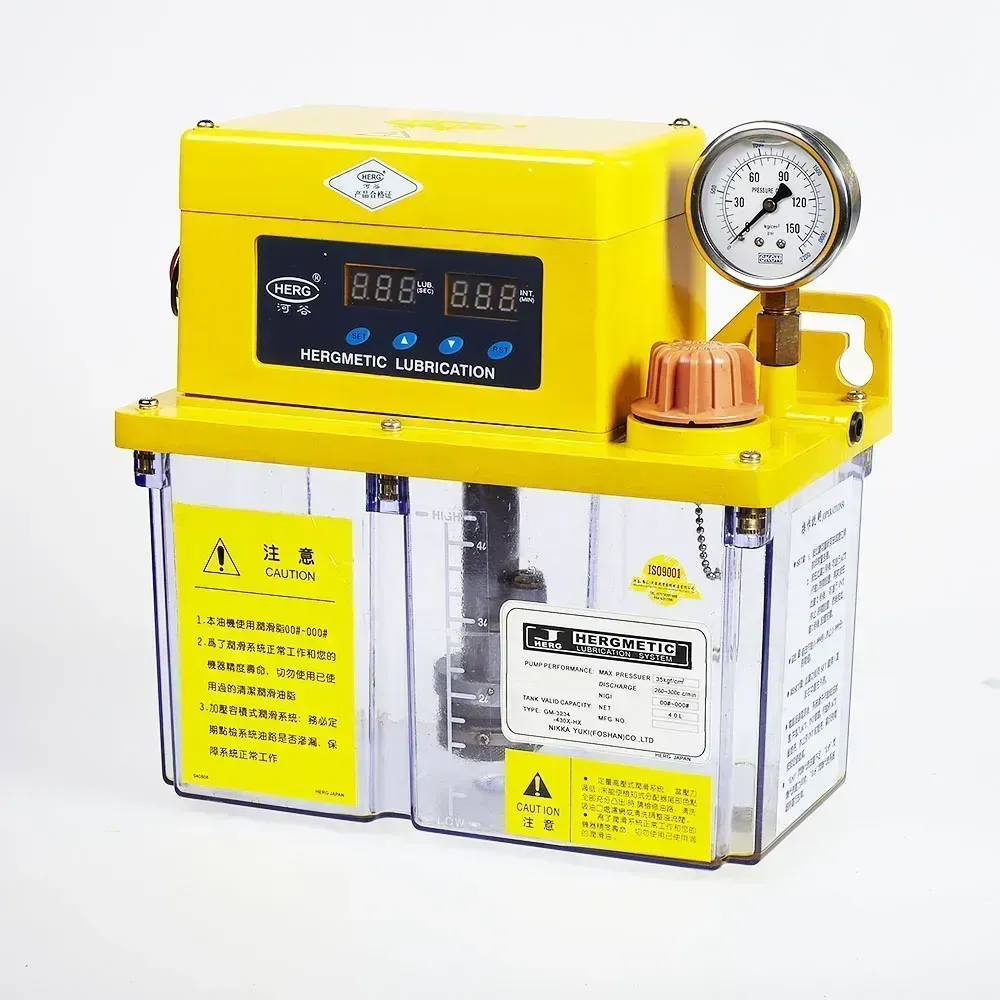 The GM: 3.5 MPa rated, NLGI 000#/00# only. The contrast case for everything below: a low-pressure volumetric pump, not a piston pump, and not rated for NLGI 2.
What the ZJ is actually for
The ZJ is a piston pump, not a gear pump with a bigger motor. One or two piston mechanisms, fixed or variable, reservoir in PC at 2 / 3 / 4 / 8 L or metal at 2 / 4 L. Controllers: none (the plant PLC owns the cycle), time-programme, or time-travel. Protection IP55. The paddle in the reservoir turns counterclockwise and exists so the inlet stays flooded even when the grease is firm enough to hold a shape, the exact channeling problem that makes NLGI 2 fatal in a GM.
It will also run the softer grades. NLGI 000#, 00#, 0# and 1# are all in the rating. "Can run 2#" is not the same as "must run 2#." Use the grade the bearing wants. Use this pump when that grade is 1# or 2#, or when the point will not accept grease at volumetric pressure.
The ZD sits under it at 18 MPa, also NLGI 000#–2#, also DC 12/24 V, one to three piston mechanisms. Same idea, middle of the high-pressure band, common on mobile plant and on moulding machines that were specced progressive rather than volumetric.
The SD and U-shaped half of the pairing
A high-pressure pump without a progressive block is just a pump. The SD series is the modular block: start and end sections sandwiching 3–10 wafers, 1–20 points, dose by wafer (SD1 0.08–0.24 ml, SD2 0.16–0.40 ml, SD3 0.40–2.40 ml). On heavy plant the SD2 is usually the master and an SD1 or SD3 sits under it as a secondary. Optimum SD2 feed tube is Ø6 mm at 1.5–4.5 m. That window is a rating, not a suggestion. Longer runs add compliance; the block stops feeling crisp.
The U-shaped is the one-piece alternative for a fixed 4, 6, 8, 10 or 12 points at 0.3 ml each, to 15 MPa, NLGI 000#–1#, −20 °C to +80 °C. M models carry a cycling feedback switch. Cycle-rate limit is 200 per minute, or 60 if a feedback switch is fitted. That switch is how a nacelle circuit reports to the ground without a climb.
Fit the indicator pin or the micro-switch. Unmonitored progressive starves every point on the block the moment one of them packs, and tells nobody. The PLC pattern (command the pump, expect N pulses inside a timeout, alarm on a miss) is in progressive distributors and PLC monitoring.
A worked contrast, not a hypothetical
Take two machines that both "need a centralised grease system."
A 120-tonne moulding clamp, twelve toggle pins and bushings, semi-fluid grease specified. This is a GM and a 35-type. 35 kgf/cm² at the pump, 30–40 kgf/cm² action at the block, NLGI 00#. Putting NLGI 2 in the GM reservoir is the failure the earlier post described: channeling, sagging pressure at the far pin, a PLC that sees a pressure fault it cannot explain. The clamp circuit is written up separately in tie bars, toggles, platens.
A turbine yaw bearing, plus pitch, plus main shaft, up a tower. This is a ZJ and an SD3, possibly with U-shaped secondaries. 30 MPa, NLGI 1# or 2# as the bearing maker specified, micro-switch on the block, pressure and level back to the SCADA. Putting 000 in that reservoir because "AMAG said centralised systems use 000" under-films a bearing that was specced for a grease that stays in the race. The pump will run. The bearing will not be what the designer signed.
Same company, same word "centralised," opposite grade. The class is what changed.
How the wrong class announces itself
NLGI 2 in a GM / 35-type / RH3-G circuit. Pressure at the distributors sags below the action window. Near points may still fire; far ones do not. The reservoir looks full while the pump eats a tunnel to the inlet. Pressure-switch trips become erratic: high against a packed line, or never, because the pump is starving. The repair is to empty the circuit, not to "turn the pressure up."
A ZJ feeding 35-type bodies, or a GM feeding an SD block. The first pairing can wreck the volumetric valves: 30 MPa into a block whose grease window tops out around 50 kgf/cm² is not more lubrication, it is a different machine. The second pairing can look as if it works and then stall in ways nobody wired an alarm for, because the GM's 3.5 MPa sits only just above the SD's 1.4 MPa start and has no reserve once the grease thickens on a cold morning. The catalogue line is there for this: mixing across the three pressure classes is the most common specification error we see.
U-shaped on NLGI 2. The U-shaped rating stops at NLGI 1#. If the bearing wants 2#, the secondary has to be an SD wafer, not a U-shaped body.
Housekeeping does not change with class
Grade mix-ups and grit still enter through the fill port. Keep the lid closed, use a dedicated transfer container, mark the reservoir with the grade and the pressure class ("GM / 00# / volumetric" is a better stencil than just "grease"). Filter what goes into a ZJ: the piston caution is specific: sand or slurry will destroy the mechanism, and the pump is rated to 30 MPa, not to a dirty yard drum.
Which post to believe
Use this one when the pump is a ZJ or a ZD, the block is progressive, and the bearing maker named NLGI 1# or 2#. Use the 000/00 post when the pump is a GM, an AP or a PJ, and the block is a 35-type, an RH3 grease build or an AD. If you are not sure which circuit you are standing in front of, read the pump nameplate before you open a cartridge. The class is stamped on it. If that nameplate belongs to someone else's pump entirely, see our centralised lubrication system replacements for how we cross a competitor's pump and distributor to the matching AMAG pairing.
For a new layout (point list, run lengths, grade, whether the plant PLC will count cycles), the design worksheet is the faster path. Send the nameplate if the machine already has a pump. We will name the class first, and the part numbers after.
Related articles
Technical Guides
CNC Lubrication System Layout: Where the Pump, Lines and Distributors Go
Sizing tells you what to buy; layout decides if you can maintain it. Pump placement, trunk and branch routing, and where distributors must sit.
Technical Guides
How to Lubricate an Injection Moulding Machine: Tie Bars, Toggles, and Platens
Oil or semi-fluid grease on the clamp, why those points want pressure-volumetric metering, and the AMAG pump pairings that match a 35-type action window.
Technical Guides
How to Set Up a Wireless MPG: Workflows That Actually Change
Five setup jobs where a wireless MPG changes how you stand and work, from indicating fixtures to first-part proving, and the habits it asks for.