RH3 Type Volumetric Distributor
Also sold as the RH-3 Inspecting Volume Type Distributor
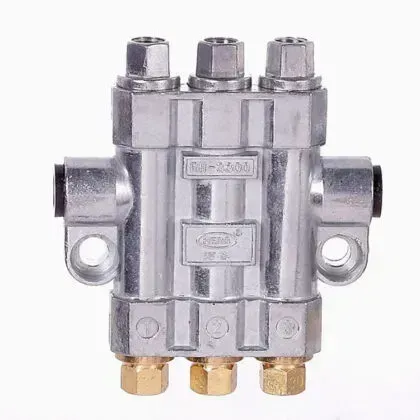
The RH3 Type Inspecting Volume Distributor is an improved second-generation design over the RH2, featuring an umbrella-shaped double-sided valve mechanism for highly accurate lubricant metering. A built-in signal pin extends during measurement and retracts during discharge, enabling real-time visual confirmation of distributor operation. Every outlet count is built for oil, for low-pressure grease (G suffix) or for high-pressure grease (GH suffix). Available in 2, 3, 4 and 5-outlet configurations, units can be combined in series to serve 6, 7 or more lubrication points.
How it works
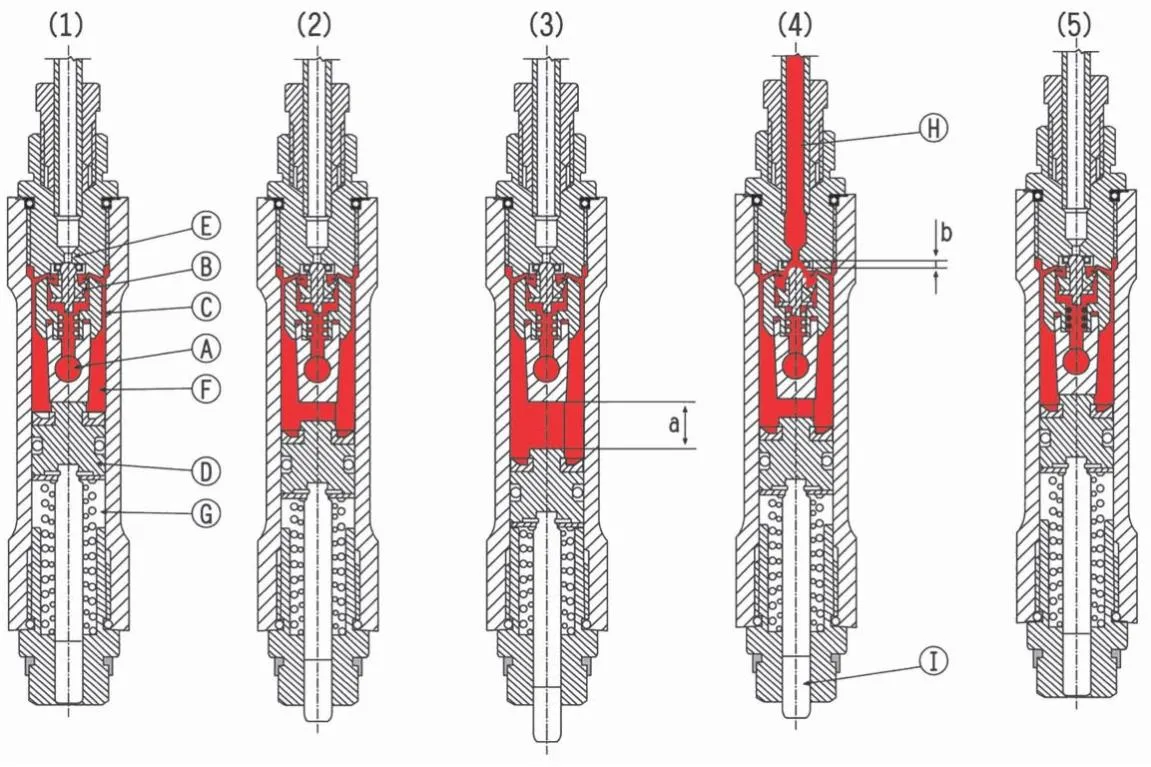
Oil injected via main tube A pushes open the umbrella-shaped double-sided valve B and is pressed into piston chamber F through path C. Driven by the pressed oil the measuring piston moves downward, spring G compresses and accumulates pressure, and metering is complete.
When pressure in main tube A is relieved, the umbrella-shaped valve moves downward under the pressure difference and opens outlet E. The measured oil in the piston chamber enters branch tube H via E and reaches the lube point. Signal pin I extends while metering and retracts on delivery, so operating conditions can be confirmed without instruments.
At low dose settings the oil chamber uses a trunk-piston structure. Blocks can be built beyond five outlets (six, seven and above) to order.
Specifications
Model matrix by order code
Every code in the table below takes one of these, appended to the code when you order.
- no suffix
- Oil
- G
- Grease, low pressure (G)
- GH
- Grease, high pressure (GH)
Models carrying G or GH are grease distributors. G is the low pressure build, GH the high pressure build.
Dimensions
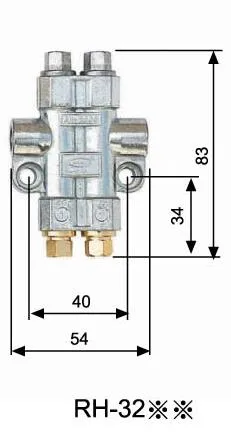
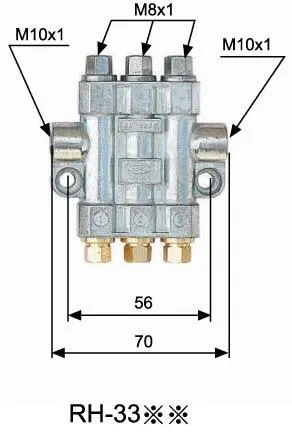
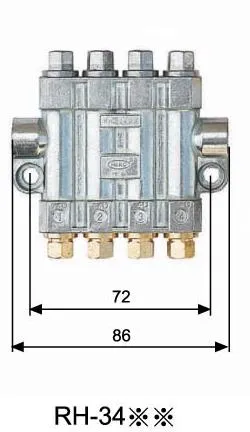
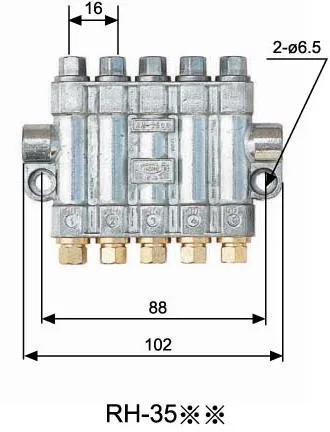
Dimensions in millimetres. Confirm critical dimensions with us before machining a mounting.
How to read the order code
- Series
- RH-3
- Number of outlets
- 2 · 3 · 4 · 5
- Discharge capacity, 1st outlet
- 03 = 0.03 ml · 06 = 0.06 · 10 = 0.1 · 20 = 0.2 · 30 = 0.3 · 40 = 0.4 ml/time
- Discharge capacity, 2nd outlet
- Blank = same capacity as the 1st outlet
- Discharge capacity, 3rd outlet
- Blank = 2-outlet block, or all outlets the same
- Discharge capacity, 4th outlet
- Blank = 2- or 3-outlet block, or all outlets the same
- Discharge capacity, 5th outlet
- Blank = 2- or 3-outlet block, or all outlets the same
- Lubricant build
- Blank = oil · G = low pressure grease · GH = high pressure grease
Before you order
- We stock blocks with the same discharge capacity at every outlet. A block with a different dose per outlet is a special order: ask before quoting one.
- The pump must have a pressure take-off mechanism. Without pressure relief the piston never returns and no dose is delivered.
- G and GH builds need a grease pump, not an oil pump: specify GM rather than TZ or HL on a grease order.
- List doses in outlet order. A single dose code means every outlet is the same. It is not shorthand for the first outlet.
Warranty
One year against manufacturing defect from date of invoice.
How it pairs
The RH3 Type Volumetric Distributor is commonly specified alongside the TZ Type Oil Lubrication Pump, the HL Type Oil Lubrication Pump, and the GM Type Grease Lubrication Pump. That is the same recommendation carried on its own datasheet, not a generic same-category suggestion.
Used on
Industry applications

Ways, ball screws and LM guides on machining centres, turning centres and routers: metered oil to every point, and a wireless handwheel for the setter.

Tie bars, toggle pins and platens on horizontal and vertical machines: oil or semi-fluid grease, metered per point and re-metered every cycle.
Cross-reference
Running one of these brands instead? This family covers the same duty as their systems, as a candidate configuration, not an automatic part-number swap. Send the nameplate code and a photo and we'll confirm the match.
Related reading
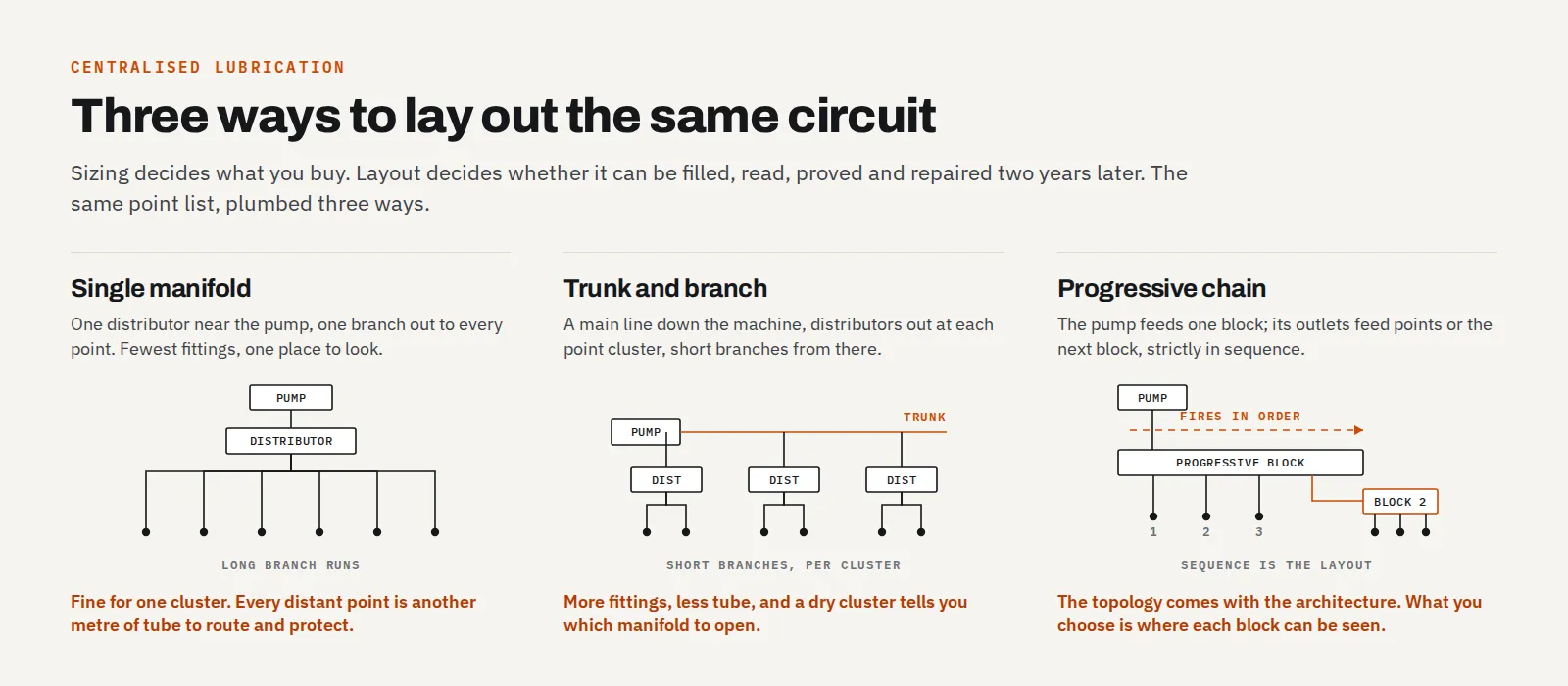
Sizing tells you what to buy; layout decides if you can maintain it. Pump placement, trunk and branch routing, and where distributors must sit.
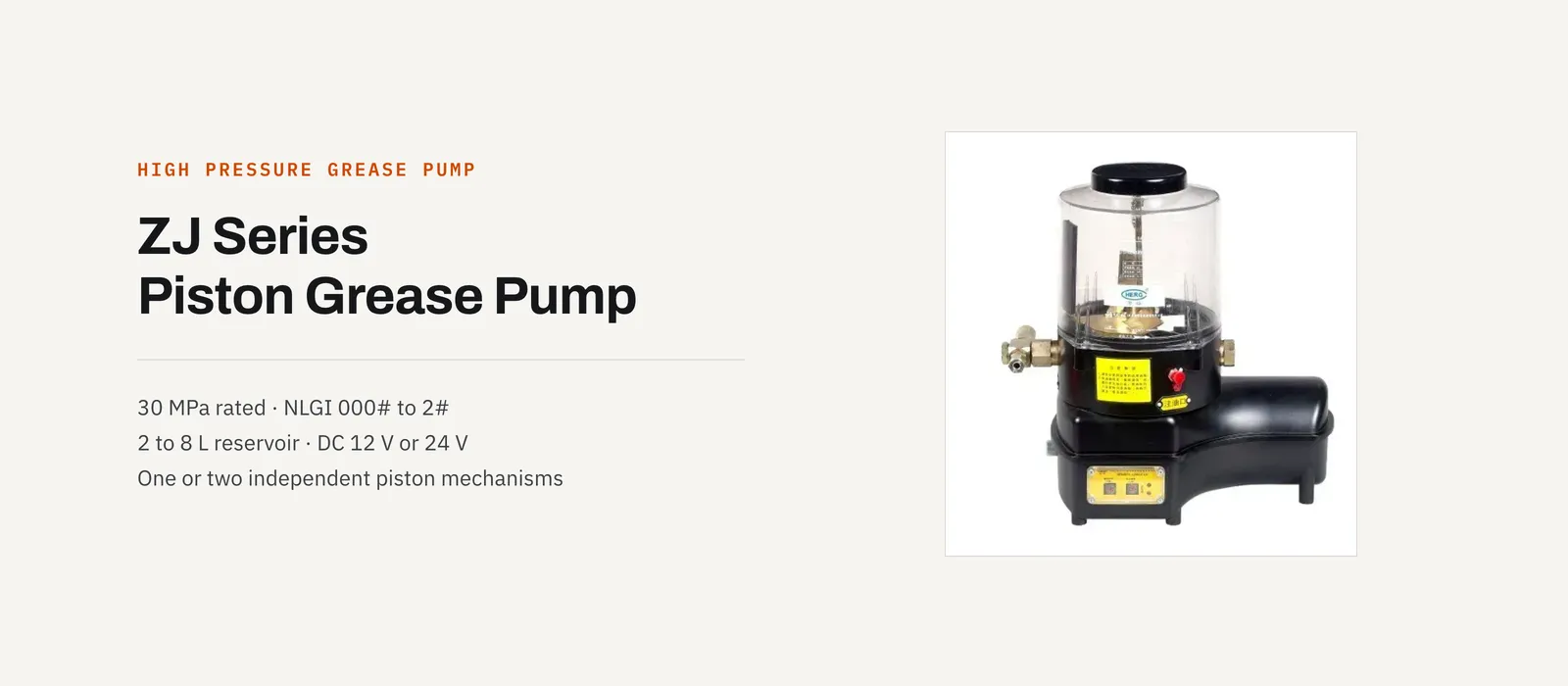
NLGI 2 belongs on a 30 MPa progressive circuit, not a GM or 35-type reservoir. The three grease pressure classes decide the grade, and what mixing them costs.
Master the essentials of CNC lubrication with our comprehensive guide covering types, best practices, and maintenance schedules.