Oil Lubrication Pumps for CNC Machines
Motor-driven gear pumps and hand-lever pumps for continuous or metered oil delivery. Level switch standard, with timer, dual-timer and digital control variants for CNC and injection-moulding lubrication circuits.
5 families · Ships pan-India
How to choose
Motor-driven or hand-lever
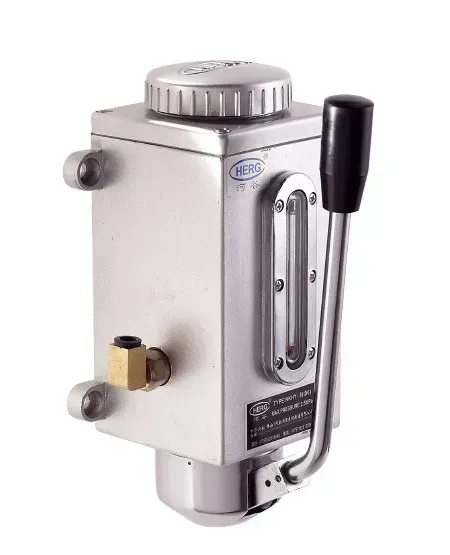
Most CNC and injection-moulding circuits run on a motor-driven pump (the TZ, HL and MTA-150 types) because a motor can hold a timed dosing schedule across a whole shift without an operator touching it. A hand-lever pump like the NKHY/PH needs no electrical supply at all: it earns its place on a single lubrication point, as a backup for a motor-driven circuit, or on machinery with no power run to the lube station in the first place.
The trade-off is consistency. A motor-driven pump delivers the same dose on the same schedule every time; a hand pump delivers a dose exactly when someone pulls the lever, which is fine for one bearing checked on a walk-round and impractical for fifteen points on a production machine.
Sizing the flow rate to the circuit
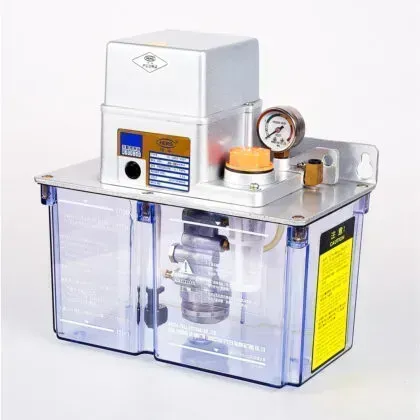
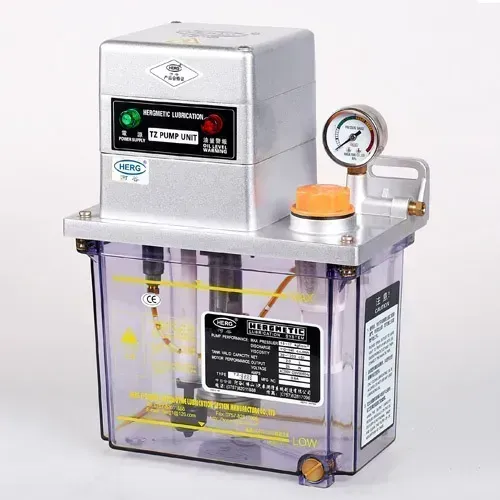
The TZ Type is the pump most CNC and injection-moulding circuits are built around: an alloy-steel gear pump rated at 110–260 ml/min at 1.5 MPa (roughly 15 kgf/cm²), with a 2 L or 4 L reservoir and a level switch fitted as standard. The HL Type covers the same flow band (110–260 ml/min at 15 kgf/cm²) and is specified where a circuit carries more lubrication points than a single TZ output comfortably feeds, without changing the metering distributors downstream.
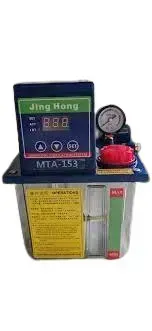
The MTA-150 sits below both: a compact thin-oil pump for small and medium machines that would otherwise be oversized by a full TZ. It carries the same standard level switch and can take an optional microcomputer control and buzzer alarm, but the pump itself is sized against a lower point count rather than against peak flow.
Timer, dual-timer or digital control
The TZ Type is available as a plain timer, a dual-timer, or the NK-3 digital variant, plus single- or three-phase motor options: the control decides how the on/off cycle is set and how easily it can be changed later, not how much oil moves per cycle. The MTA-150 offers a comparable step up: standard level-switch operation, or an optional microcomputer for free-form time setting with a buzzer alarm carrying both NO and NC outputs. A pressure switch is optional on the TZ and available to order on the MTA-150, for circuits where a machine PLC needs to see line pressure rather than just reservoir level.
Metered dosing versus circulating flow
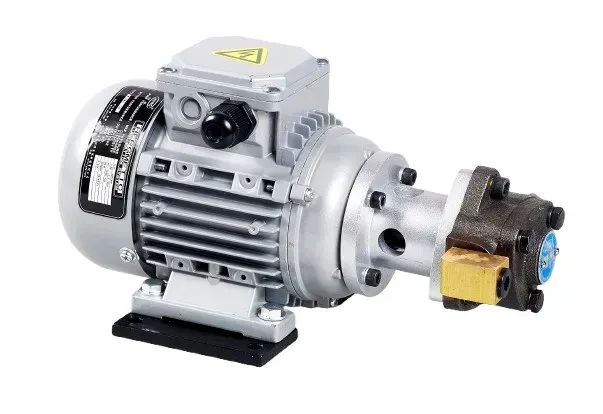
Everything above meters oil in doses, feeding a distributor that splits each dose across several points: total-loss lubrication, where the oil is used once and not returned. The BM Series Cycloidal Pump works differently: it delivers a continuous, near pulsation-free flow of 1.2–7.5 L/min at up to 5.0 kgf/cm², sized by frame and speed rather than by dose. That makes it a circulating-lubrication pump (gearbox oil baths and similar continuous-flow duties) rather than a fit for a distributor-fed, point-by-point circuit. Choosing between a BM pump and a TZ/HL/MTA-150 pump is really a question of which lubrication architecture the machine uses, not which pump is "better."
Matching the pump to a distributor
A metering pump on its own only pushes oil into a line. Splitting that flow across multiple points accurately is the distributor's job. The TZ Type is specified to pair with 35 Type volumetric distributors, RH3 Type inspecting volume distributors, and TCJ/TCZ resist-type distributors; see the distributors page for how those three metering architectures differ and which one suits a given point count and monitoring requirement.
Tell us the machine, the number of lube points and the interval. We will name the model and the matching distributors.
WhatsApp an engineer+91 73976 31796Replacing an existing oil lubrication system?
If your machine is running an older centralised oil lubrication system, send AMAG a photo of the pump or nameplate. We will configure the replacement pump, distributor, tubing and fittings package around the required output and existing installation.
Which oil pump for which job
A quick reference across the five oil pumps in the catalogue, grounded in their published flow, pressure and power specs.
| Use case | Best for | Flow / output | Power |
|---|---|---|---|
| TZ Type | Multi-point CNC and injection-moulding circuits feeding a volumetric or inspecting distributor | 110–260 ml/min at 1.5 MPa (≈15 kgf/cm²) | Single- or three-phase motor; timer, dual-timer or NK-3 digital control |
| HL Type | Circuits carrying more lubrication points than a single TZ output comfortably feeds | 110–260 ml/min at 15 kgf/cm² | Motor-driven, 2 L or 4 L reservoir |
| MTA-150 | Small and medium machines that would be oversized by a full TZ circuit | Thin oil only, sized against point count rather than peak flow | Level switch standard; optional microcomputer and pressure switch |
| BM Series | Continuous circulating lubrication (gearbox oil baths) rather than metered dosing to a distributor | 1.2–7.5 L/min, near pulsation-free, up to 5.0 kgf/cm² | Motor-driven cycloidal rotor; PT1/8, PT1/4 or PT3/8 ports |
| NKHY / PH | A single lubrication point, backup dosing, or machinery with no power at the lube station | 8 cc/stroke (NKHY) or 16 cc/stroke (PH-1600) at 15–25 kgf/cm² | Manual hand-lever: no electrical supply or timer needed |
Oil pumpsLubrication Systems5
Frequently asked questions
What's the difference between the TZ and HL type oil pumps?
Both are motor-driven alloy-steel gear pumps covering the same 110–260 ml/min flow band with a 2 L or 4 L reservoir and a standard level switch. The TZ Type adds timer, dual-timer and NK-3 digital control variants for scheduled dosing; the HL Type is specified where a circuit needs that flow spread across more lubrication points than a single TZ output is sized for.
When should I choose a hand-lever pump instead of a motor-driven one?
The NKHY/PH hand-lever pump needs no electrical supply, so it fits a single lubrication point, a backup for a motor-driven circuit, or machinery with no power run to the lube station. A motor-driven pump like the TZ is the better fit wherever a schedule has to run unattended across a shift.
Which distributors pair with the TZ Type pump?
The TZ Type is specified to work with 35 Type volumetric distributors, RH3 Type inspecting volume distributors, and TCJ/TCZ resist-type distributors. Which of the three suits a given circuit depends on point count and whether the circuit needs per-point proof of delivery. See our distributors page for the comparison.
What's the difference between the BM cycloidal pump and the other oil pumps here?
The TZ, HL, MTA-150 and NKHY/PH all deliver metered doses into a line feeding a distributor: total-loss lubrication. The BM Series Cycloidal Pump instead delivers a continuous, near pulsation-free flow of 1.2–7.5 L/min, which suits circulating-lubrication duties such as a gearbox oil bath rather than point-by-point dosing.
Does an oil pump come with a level switch as standard?
Yes on the TZ and MTA-150 types: both carry a level switch as standard, with a pressure switch available as an option (built-in on the TZ, to order on the MTA-150) for circuits where a machine PLC needs to see line pressure as well as reservoir level.
How many lubrication points can one oil pump feed?
That depends on the distributor downstream, not the pump alone: a pump supplies pressurised oil to a line, and a distributor meters it out per point. As general guidance, size the pump's flow rate to the total dose your distributor layout needs per cycle, with margin for line length and viscosity; our sizing worked example below walks through the arithmetic for a typical machine.
Related reading
On a total-loss system every timer setting is an oil consumption and coolant-life decision. How intermittent pumping works and how to tune it.
A step-by-step sizing walkthrough for a 3-axis vertical machining centre, from counting lube points to distributors, reservoir, and timer.
What ISO VG grades actually measure, why slideway oil is its own category, and how your lubrication hardware limits which oil you can run.
A practical guide to selecting the perfect lubrication system for your CNC machine, injection moulding equipment, or industrial machinery.