Technical Guides
Total-Loss Lubrication: Setting Intervals and Doses That Make Sense
AMAG Team7 min read
The way-lube system on most CNC machine tools is a total-loss system, and the name means what it says. Fresh oil is metered to the ways and ballscrews, does its job once, and is lost. It gets scraped off by wipers, carried away on chips, or washed down by coolant into the chip pan and coolant sump. Nothing returns to the reservoir, unlike a recirculating system, where the same oil loops continuously back to the tank.
That fact changes what your timer settings mean. On a recirculating system, flow settings are a purely mechanical concern. On a total-loss system, every shot the pump delivers is oil you purchased leaving the building, and a portion of it lands in your coolant on the way out. The interval and dose you program amount to a consumption decision and a coolant-life decision, executed automatically thousands of times.
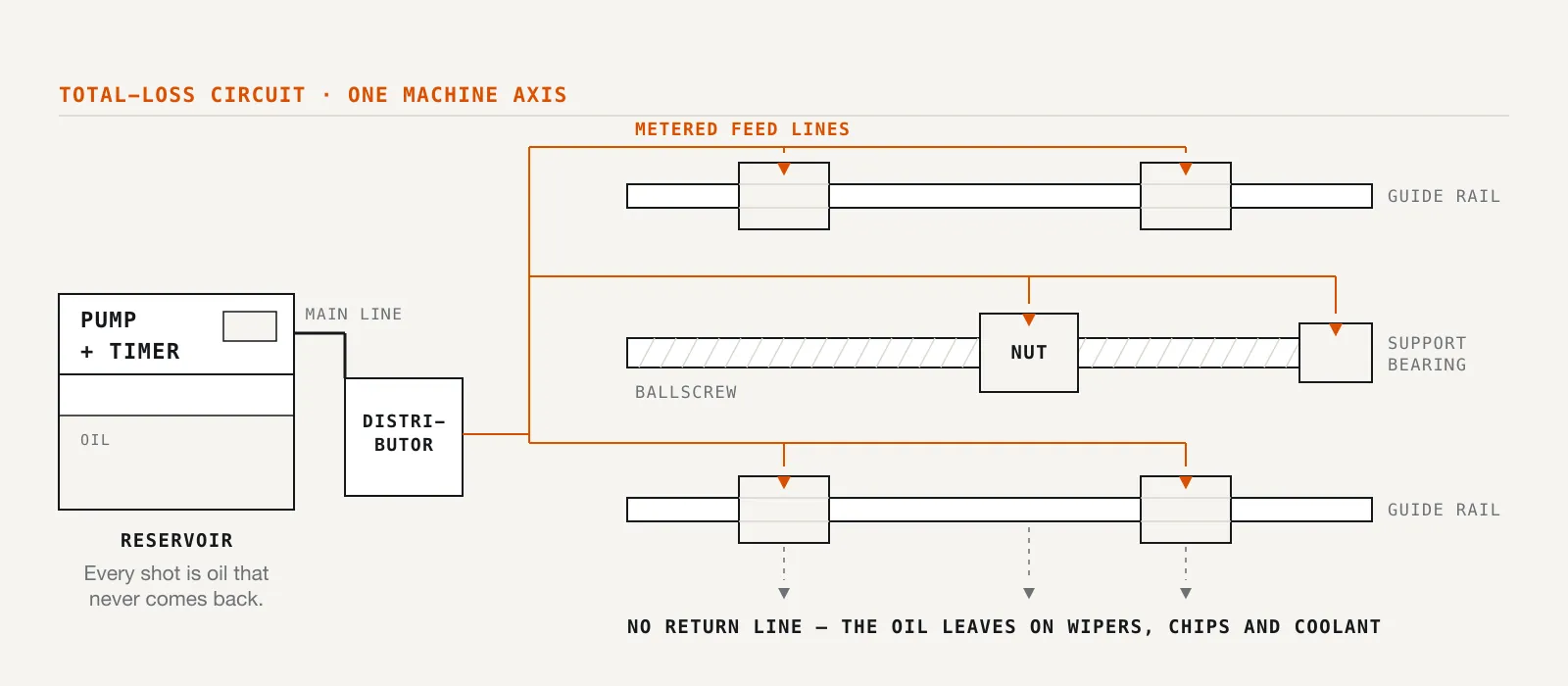 Way-lube plumbing on a machine axis: metered oil goes out, does its job once, and ends up in the chip pan.
The two ways a setting goes wrong
Because the oil only travels one direction, the failure modes point in opposite directions too, both visible if you know where to look.
Too much oil shows up in the coolant sump. Way oil that reaches the coolant becomes tramp oil: a surface film, a sour smell as the coolant degrades, and shorter coolant life. Skimmers and coalescers pull tramp oil back out, but that only treats the symptom: a lube system delivering more than the ways can hold. The other tell is a reservoir needing topping up more often than the duty cycle suggests.
Too little oil shows up on the ways themselves. Surfaces that should carry a visible oil film run dry, and the machine develops stick-slip at creep feeds: the axis grips and lurches instead of creeping smoothly, showing up as jerky slow-speed motion and positioning error on finishing passes. Dry-looking ways are the early warning here, not the jerky motion that follows once the film has gone marginal.
In practice, dialing in a setting means watching for both signs and nudging away from whichever one shows up.
How intermittent pumping actually works
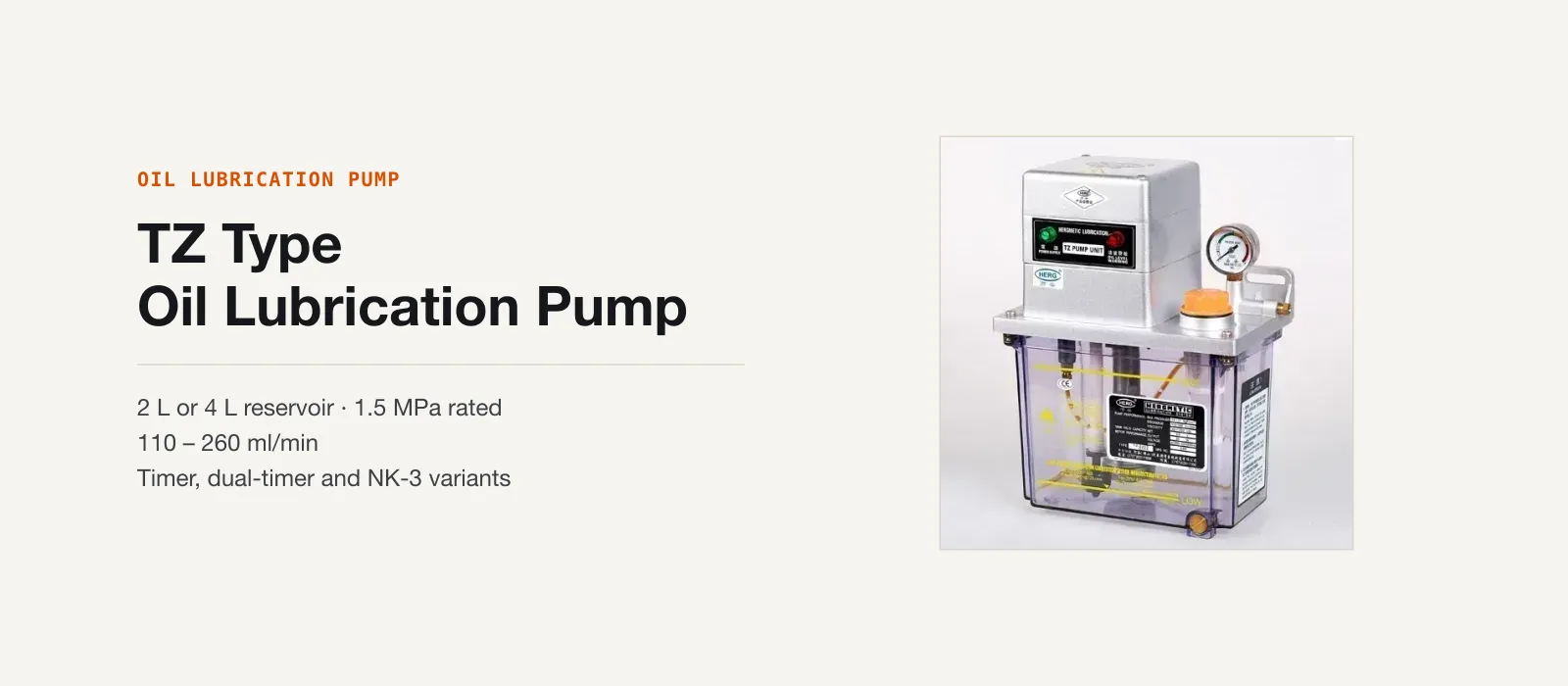
To set the knobs sensibly, you need to know what one lubrication cycle physically is: take the TZ type motor-driven oil pump feeding volumetric distributors, a standard arrangement.
The TZ's special alloy steel gear pump starts and pressurises the line. Its rated pressure is 15 kgf/cm², with a maximum of 25 kgf/cm² in reserve, enough to bring the line up to the action pressure at which volumetric distributors fire and inject their fixed, metered dose into each feed line.
Once fired, the pump stops, the line vents, and the distributors refill their metering chambers, ready for the next cycle. Pressure rise, discharge, vent, refill: one shot of lubrication delivered to every point at once.
This is why an intermittent system has two knobs:
- Interval: the time between cycles, and the dominant consumption knob. Halve it and you double the oil consumed, every day, indefinitely.
- Discharge time: how long the pump runs each cycle. It needs to be long enough for the line to reach action pressure and every distributor to fire, including the farthest one on a cold morning when the oil is thick. Beyond that, extra run time pushes out no extra oil, since the distributors are volumetric. Too short, though, and distant points fire unreliably or not at all.
The dose itself lives in the distributor metering, set by hardware selection, not the timer. Matching delivered volume to the machine's needs is a sizing exercise, worked through in sizing a CNC lubrication system.
Three timer configurations, three kinds of machine
The TZ pump family comes in three timing configurations; the right one depends on who should own the schedule.
No timer (TZ-2202 / TZ-3202). The pump is a dumb actuator. The machine control or an external PLC decides when it runs, the common CNC arrangement, since builders typically tie lubrication to spindle or axis run-time, so the machine doses on usage, not time powered on. A second, independent timer on a control that already owns the schedule just creates two masters and no accountability.
Built-in microcomputer dual-timer (TZ-2212 / TZ-3212). The pump carries its own self-contained timer module for both interval and discharge time. It suits equipment with no control capable of owning the schedule, or retrofits where wiring lube logic into an older control isn't worth the trouble.
NK-3 digital display timer (TZ-2232 / TZ-3232). Same self-sufficiency, but with a digital display and push-button setting. Settings you can read at a glance get checked and adjusted more often than ones buried in a module. That visibility is worth it on standalone machines where an operator or tech actively tunes intervals.
Each configuration is available in 2 L and 4 L reservoir variants, and the TZ can be ordered with or without a pressure take-off, serving both volumetric and resist-type distribution.
Reasoning about the interval
Machine-hours beat wall-clock time. A machine idle all weekend doesn't need dosing on Saturday: its ways aren't moving and its film isn't being consumed. Demand tracks axis travel and running time, not the calendar. That's the argument for the no-timer configuration: it scales automatically with use. On a standalone timer, set the interval for your real duty cycle and accept some over-servicing during idle time, or power the lube system with the machine so idle days don't dose at all.
The builder's manual is the starting point, not the endpoint. The builder specified an interval and dose based on way area, load, and materials, not your duty cycle, coolant, or climate.
Then observe. The ways should show a visible film (a sheen, not puddles) after running, and the coolant shouldn't grow an oil layer overnight. A rainbow film each morning means the machine is delivering more oil than the ways can use. Adjust the interval one direction at a time, give it days rather than hours to show effects, and let those two settle it.
The guards: level switch and pressure switch
A total-loss system consumes its reservoir by design. Running dry is the scheduled outcome of consumption plus inattention, not a mechanical failure. That's why the TZ pump carries a level switch as standard equipment: the low-level signal turns "the reservoir quietly emptied and the ways ran dry for a week" into an alarm on day one. Wire it into the machine's alarm chain, not just a local lamp.
The optional pressure switch (available in 5 or 10 kgf/cm² ratings) guards the opposite failure: the pump runs but pressure never builds, whether from a leaking fitting, a split line, or a pump problem. Without it, a cycle that delivers nothing looks identical to one that worked, since the timer only knows the motor ran. Wired in, it turns that failure into an alarm instead of a mystery discovered months later as way wear.
That switch is cheap insurance on a lights-out machine. The diagnostic sequences it feeds into are covered in troubleshooting centralised lubrication.
Dialing it in and leaving it alone
A well-set total-loss system is quiet. The ways carry their film, the coolant stays clean, the reservoir empties at a predictable rate, and the level switch is the only thing that ever asks for attention. Pair the right timer configuration with the right oil (grade selection is covered in the machine tool oil viscosity guide), and the system needs little attention for years at a stretch.
If the pump itself is what nobody can explain, worn past adjusting or simply unlabeled, see our centralised lubrication system replacements for how we identify what's actually on the machine and pair a new pump and distributor around it.
If you're specifying a pump and timer configuration, or inheriting a system whose settings nobody can explain, get in touch and we'll help you work through it.
Related articles
Technical Guides
CNC Lubrication System Layout: Where the Pump, Lines and Distributors Go
Sizing tells you what to buy; layout decides if you can maintain it. Pump placement, trunk and branch routing, and where distributors must sit.
Technical Guides
When a Centralised Grease System Can Run NLGI 2
NLGI 2 belongs on a 30 MPa progressive circuit, not a GM or 35-type reservoir. The three grease pressure classes decide the grade, and what mixing them costs.
Technical Guides
How to Lubricate an Injection Moulding Machine: Tie Bars, Toggles, and Platens
Oil or semi-fluid grease on the clamp, why those points want pressure-volumetric metering, and the AMAG pump pairings that match a 35-type action window.