Technical Guides
Machine Tool Oil Viscosity: What the Numbers Mean and Why Your System Cares
AMAG Team7 min read
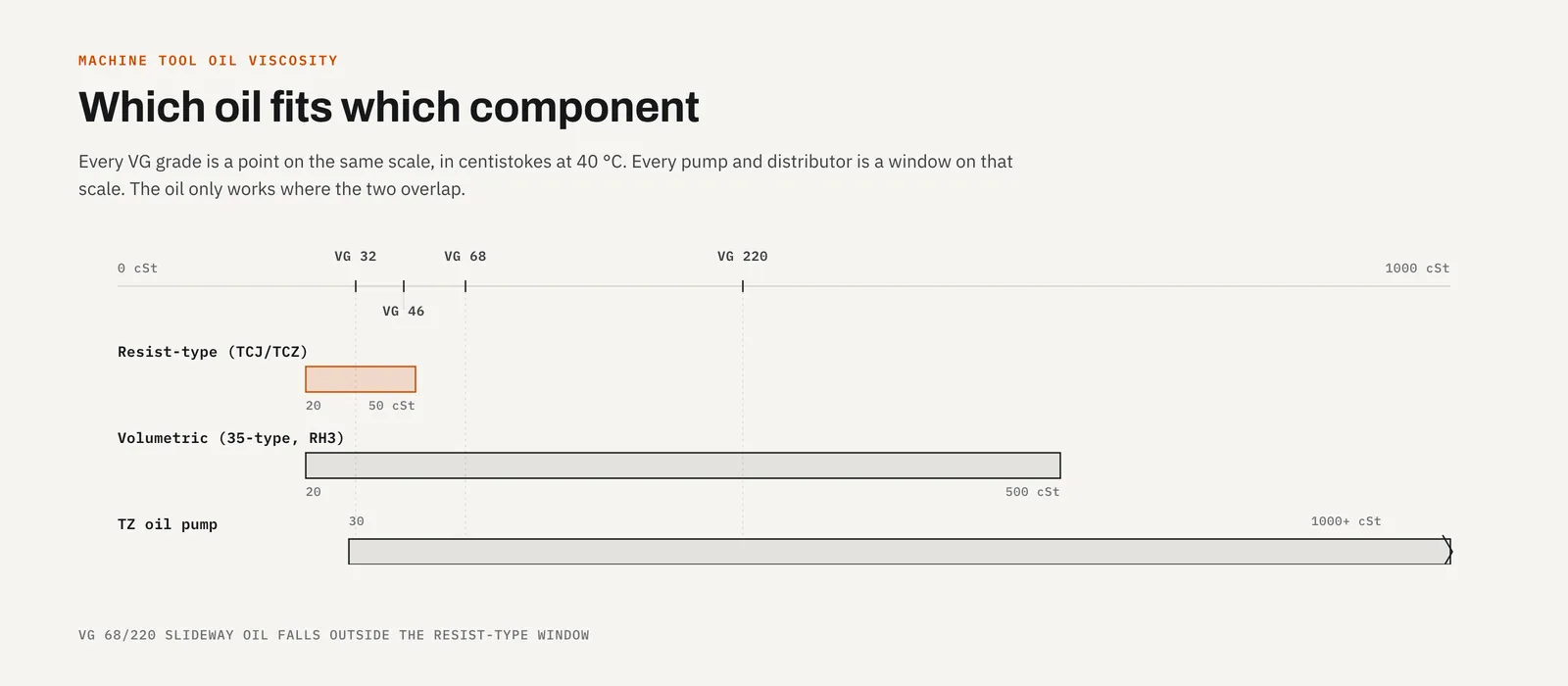
Every drum of machine oil carries a viscosity grade, and most people treat it like a shoe size: match the number in the manual and move on. That works until someone tops up the way-lube tank with hydraulic oil, or specs a heavy slideway oil into a metering system never designed to push it. Viscosity is a design input for every pump, line, and distributor the oil travels through. This guide covers what the ISO VG number tells you, why slideway oil is its own category, and how the lubrication system constrains your choice.
What an ISO VG number actually measures
The VG number is the oil's kinematic viscosity in centistokes (cSt) at 40 °C: an ISO VG 68 oil measures 68 cSt at 40 °C. Each grade covers a band of ±10% around that figure, so a VG 68 oil can legitimately sit anywhere from roughly 61 to 75 cSt at reference temperature. That's valid only at 40 °C, and the scale is stepped, not continuous: "a bit thicker than VG 46" in practice means jumping to VG 68.
Machine tools cycle through a few rungs of that ladder:
| Grade | Typical machine-tool duty |
|---|---|
| VG 32 | Hydraulic systems and spindle-adjacent uses where low drag matters |
| VG 46 | Hydraulic and general-purpose duty, similar territory to VG 32 |
| VG 68 | The widely used slideway oil on smaller machines |
| VG 220 | Heavier slideways where load and geometry demand a thicker film |
Light, fast-moving elements want thin oil that shears easily. Heavy, slow-moving surfaces need a thicker film, one that won't squeeze out from under load.
Slideway oil is not just thick oil
A VG 68 hydraulic oil and a VG 68 slideway oil share a viscosity at 40 °C, so on paper they look interchangeable. They aren't: slideway oils are formulated for a job plain oils fail at.
A slideway is a terrible environment for an oil film. Gravity constantly pulls it off vertical and inclined ways, flood coolant sprays at it for hours washing it away and emulsifying it, and the way itself moves slowly under high load. That's the regime where a hydrodynamic film cannot form, so the oil works in boundary lubrication, with metal asperities nearly touching through a molecularly thin layer.
Slideway oils answer with two kinds of chemistry. Tackifiers make the oil stringy and adhesive, so the film clings to a vertical way and resists coolant washoff.
Boundary-lubrication additives handle the low-speed, high-load regime. This is where stick-slip shows up: the way grips, elastic wind-up builds in the drive, then releases and lurches forward at very low feed rates, leaving positioning error and marks on a finishing pass at creep feed. Tackified way oils with boundary additives keep static and dynamic friction close, so the axis creeps smoothly. A plain hydraulic oil of the same viscosity offers none of that protection, which is why "the machine chatters on slow moves ever since we switched oil" is such a recognisable service call.
Your lubrication system votes on the oil too
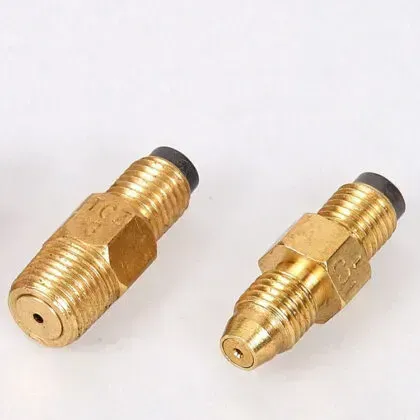 TCJ/TCZ restrictor elements metre by resistance through a damping hole, which is why their oil window stops at 50 cSt.
Before the oil touches a way or ballscrew, it must be pulled from a reservoir, pushed down metres of small-bore tubing, and forced through metering valves. Each is designed around a viscosity range that an out-of-range oil breaks.
The 35-type pressurised volume distributors and RH3 inspecting distributors, the volumetric workhorses described in how volumetric distributors work, are rated for oils of 20–500 cSt, a window generous enough to cover everything from VG 32 hydraulic oil up through VG 220 heavy way oil, which is why volumetric distributors are the default for slideway systems.
The TCJ/TCZ resist-type distributors are a different story. They metre by restriction: a precision damping hole throttles flow so each point gets oil proportional to its restrictor size, which only holds if the oil's flow resistance stays within design assumptions.
The TCJ/TCZ family is rated for 20–50 cSt oil only. VG 32 fits, VG 46 sits at the edge of the window at reference temperature, and VG 68 or VG 220 way oil doesn't belong in a resist system, since heavy tackified oil in restrictors sized for thin oil breaks the intended proportions. A machine that needs heavy way oil should use a volumetric architecture instead.
The pump has its own window: the TZ type motor-driven oil pump uses a special alloy steel gear pump with good self-priming, rated for 30–1000 cSt, wide enough for every common way oil including VG 220 and beyond. Not every pump is that tolerant; one straining against thicker oil shows slow pressure build and sluggish cycles even when nothing is technically "broken."
Temperature moves the numbers
The 40 °C reference point is the whole caveat. Viscosity falls steeply as temperature rises, so oil in a reservoir on a cold shop-floor morning is meaningfully thicker than after hours of spindle time have warmed the machine casting around it.
A system commissioned on cold winter oil delivers differently at summer running temperature. An oil near the thick edge of a component's viscosity window may exceed it entirely at cold start, and the pump labours through the first cycles of the day. That doesn't mean chasing seasons with different grades. It means evaluating marginal choices at your real cold-start temperature instead of the 40 °C book figure, and leaving margin inside the component windows rather than sitting on their edges.
A selection sequence that holds up
- Start with the machine builder's manual. The builder specified a grade, usually a tackified slideway oil for the ways and ballscrews, based on way material, geometry, and loads. That specification wins by default.
- Verify every component in the delivery path accepts that grade: pump rating, distributor type and window, metering principle. A volumetric system rated 20–500 cSt swallows any common way oil; a resist system's 20–50 cSt window rules most of them out.
- Check the operating environment, since cold starts, hot shops, and coolant exposure all push towards the tackified, properly additised product rather than whatever generic oil matches the number.
- Then set your dosing. Viscosity and dosing interact: how much and how often is its own subject, covered in setting total-loss intervals and doses.
The mistakes that keep showing up
Filling ways with hydraulic oil, by accident (a low reservoir topped up from the nearest drum) or on purpose (it was cheaper or already in stock). The viscosity may match, but the tackifiers and boundary additives aren't there, and the symptom, stick-slip and wear, arrives weeks later.
Mixing grades. Blending VG 32 into VG 68 produces an oil of intermediate viscosity that matches no specification, and additive packages from different products aren't guaranteed to cooperate. If a mixed fill happened, draining and refilling beats guessing.
Ignoring the system rating: specifying oil for the friction surfaces alone, then discovering the distributors were never rated for it. That mismatch takes five minutes to catch with the datasheets, which is exactly when it should have been caught.
Getting the whole chain right
Viscosity selection touches three domains at once: the friction surfaces that need a particular film, the formulation that keeps the film in place, and the hardware that has to metre the oil every cycle. When all three agree, the system disappears into the background, as good lubrication should.
If you're specifying a new system or reconciling an oil change with existing hardware, talk to us: matching lubricant, distributors, and pump into one system is exactly the work we do.
Related articles
Technical Guides
CNC Lubrication System Layout: Where the Pump, Lines and Distributors Go
Sizing tells you what to buy; layout decides if you can maintain it. Pump placement, trunk and branch routing, and where distributors must sit.
Technical Guides
When a Centralised Grease System Can Run NLGI 2
NLGI 2 belongs on a 30 MPa progressive circuit, not a GM or 35-type reservoir. The three grease pressure classes decide the grade, and what mixing them costs.
Technical Guides
How to Lubricate an Injection Moulding Machine: Tie Bars, Toggles, and Platens
Oil or semi-fluid grease on the clamp, why those points want pressure-volumetric metering, and the AMAG pump pairings that match a 35-type action window.