Technical Guides
How a Volumetric Distributor Works: Metered Lubrication Explained
AMAG Team7 min read
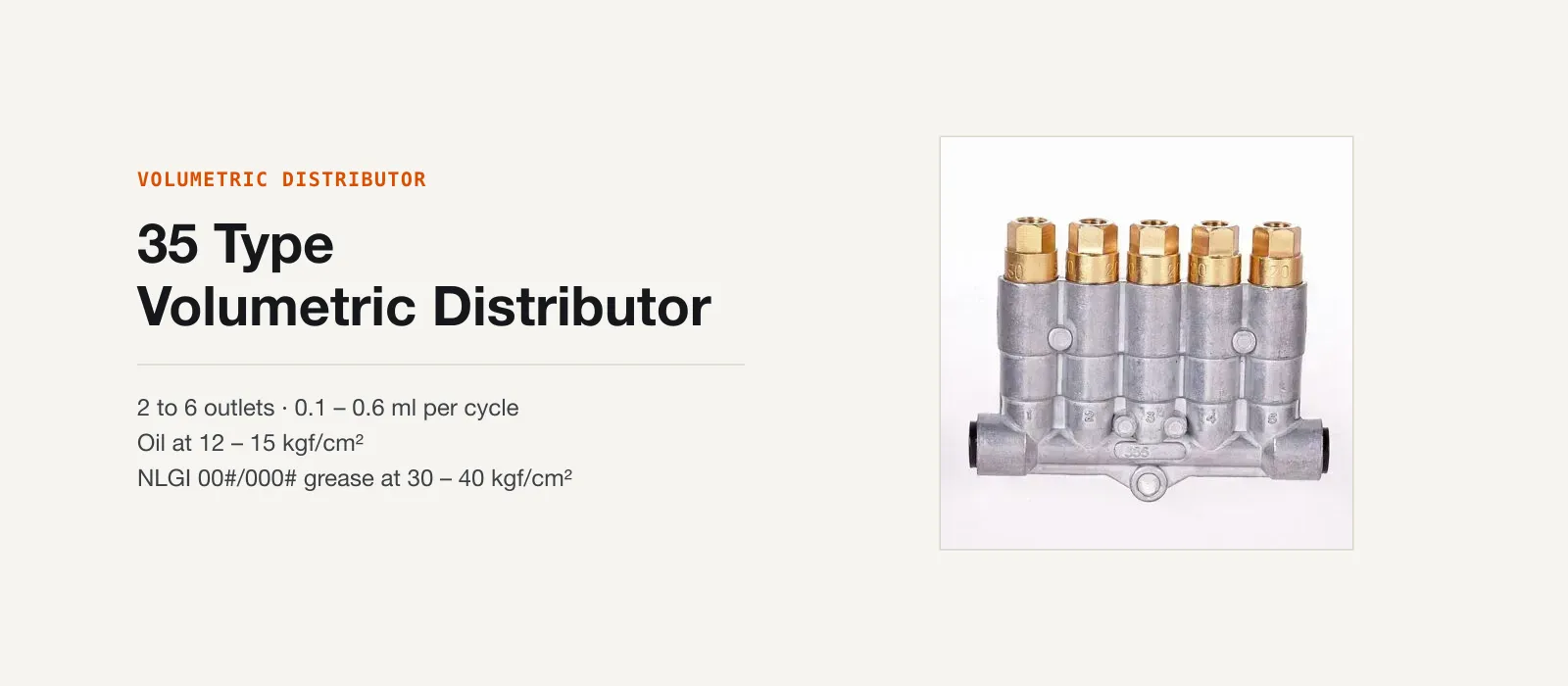
A lubrication pump takes oil from a reservoir and pushes it into a line under pressure. It has no opinion about where that oil ends up. On a machine with fifteen or twenty lubrication points fed through lines of different lengths and back-pressures, deciding that is the whole problem, and it belongs to the distributor. How it decides separates a system that protects a machine from one that merely consumes oil, and the AMAG 35-type pressurised volume distributor is the clearest place to see the difference.
Why you can't just split the line
The naive way to feed many points from one pump is a drilled manifold or a chain of tee fittings: one inlet, several open outlets, let the oil sort itself out. It does, badly: flow through parallel paths divides by resistance: run length, tube bore, fittings and bends, and the back-pressure of the point itself. A short run to a way wiper two hundred millimetres away is a far easier path than a three-metre climb up the column to the spindle head.
Given the choice, almost all of the oil takes the easy path. The near points end up drowned in oil while the far ones run dry, and the gauge on the pump shows nothing wrong, because the pump moves its rated flow either way. Usually nothing shows up on the starved point until the way surface wears or an axis develops stick-slip at low feed rates.
It gets worse: the split isn't stable, either. Oil viscosity falls as temperature rises, shifting the balance between branches as the machine warms through a shift, and load changes the back-pressure a bearing presents. A system tuned with needle valves on a cold morning behaves differently by mid-afternoon, and re-balances again the day someone swaps in a tube of slightly different length. Open parallel paths distribute pressure drop; a bearing needs volume.
Metering by displacement instead of resistance
A volumetric distributor takes the plumbing out of the decision. Behind each outlet sits a metering chamber of fixed volume with a piston. One phase fills it from the supply line; the other sweeps the piston and pushes its contents out. The point at the end of that line receives the chamber's volume every cycle, not an approximation that depends on conditions cooperating. The dose is defined by machined geometry rather than by whatever resistance sits downstream.
This is what positive displacement means in practice. Outlets are no longer in hydraulic competition, because each dose is sealed off from its neighbours while it's delivered. Long and short lines get their measured amounts independently, and back-pressure differences between points stop mattering within the system's working range. The plumbing itself just carries oil now; it no longer divides it.
The pressurised volume cycle in the 35-type
That leaves one question: what tells the pistons when to fire? In the 35 Type pressurised volume distributor, the answer is the system pressure itself.
The pump pressurises the main line. When line pressure climbs past the distributor's action guarantee pressure, 12–15 kgf/cm² for oil, or roughly 12–15 bar since a kgf/cm² is within about two percent of a bar, every metering element injects its measured dose into its outlet line. When the pump stops and the line is relieved, pressure falls away, the elements return, and each metering chamber refills from the main line.
One pressurise-and-vent cycle of the pump produces exactly one dose at every outlet. The pump timer decides how often lubrication happens; the distributor decides how much each point gets. Neither disturbs the other, which keeps sizing arithmetic honest: points times dose gives volume per cycle, and cycles per day turns that into daily consumption. We walk through a real machine layout in our sizing worked example.
Two consequences follow. First, the system must reach action pressure, and a weeping fitting, cracked tube, or dry reservoir keeps it from getting there, silently, which is why a pressure signal belongs in the machine's alarm chain. Second, line pressure has to fall between cycles too, since the metering chambers only refill on the drop: a pump that dead-heads the line and holds it at pressure never lets the distributor recharge, which is why pumps built for volumetric systems relieve the main line after each shot.
On the fluid side, the 35-type is specified for oil of 20–500 cSt, a range covering common machine-tool slideway oils. ISO VG numbers are kinematic viscosity in cSt at 40 °C, so a typical VG68 way oil sits well inside that window. There are also grease versions running 00# and 000# semi-fluid grades, with a higher action guarantee pressure of 30–40 kgf/cm² to suit how grease moves through small lines.
One manifold, different doses
The points on a real machine do not want equal amounts of oil, which is where the 35-type's metering earns its keep. Each outlet dispenses between 0.1 and 0.6 ml per cycle, and the dose is configurable per outlet, not per distributor.
Picture one distributor feeding a ballscrew nut, a pair of linear guide trucks, and a way wiper whose only job is keeping a film on a scraped surface. The nut consumes its film doing real work; the wiper needs a fraction of that. Deliver the same dose everywhere and you're forced to either overfeed the light points, producing tramp oil and unaccountable consumption, or starve the heavy ones into wear you can't undo. A larger dose on the ballscrew outlet and the minimum on the wiper, same manifold, same cycle, solves that without extra hardware.
The family comes in 2-, 3-, 5-, and 6-outlet bodies, the 352XX, 353XX, 355XX, and 356XX model lines, so a manifold can be matched to the point cluster it serves. Several distributors can hang off one main line, all triggered by the same cycle, which is how a seventeen-point machine ends up served by three manifolds and one small pump.
The compact option for small machines
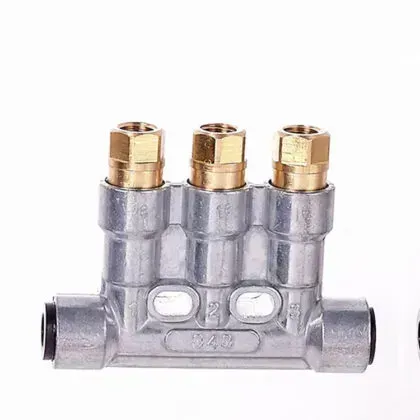 The 34-type: the same fixed-dose-per-outlet principle in a compact 2- to 5-outlet body.
Not every machine needs that much manifold. For small CNC machining centres, light machine tools, and printing or packaging equipment, the 34 Type volumetric distributor gives the same fixed-dose behaviour in a compact, modular body of 2, 3, 4, or 5 outlets. Its numbers sit a step below the 35-type's: 0.03–0.16 ml per outlet per cycle, fired by an action guarantee pressure of 8–12 kgf/cm², and oil only, with no grease build in the family. It suits a handful of light points clustered close together, keeps installation simple, and leaves cabinet room.
Whichever body you choose, treat cleanliness as part of the design. Metering chambers and their valves are small precision assemblies, and grit from a dirty first fill or an open reservoir lid is exactly the right size to jam them. Clean transfer containers and a closed lid are unglamorous, but skipping them is how distributors fail.
Where volumetric metering is the wrong tool
Positive displacement isn't the only way to divide oil, nor always the right one. Resist-type distributors such as the TCJ/TCZ family take the opposite approach, letting oil flow continuously and dividing it proportionally through calibrated damping holes. There are no cycles and no action pressure, just a fixed ratio, suited to lightly loaded points that want a small continuous feed. Progressive distributors fire their outlets in strict mechanical sequence from a single line instead, which changes how the whole system fails. What each does when a line blocks is different, and worth its own discussion: see our comparison of lubrication architectures.
From principle to pipework
A volumetric distributor makes lubrication deterministic: the geometry sets the dose and the pressure cycle sets the timing, so the tubing layout stops being something you have to compensate for. If you're looking at a machine of your own, start with an overview of the full range of lubrication systems and work from there.
Related articles
Technical Guides
CNC Lubrication System Layout: Where the Pump, Lines and Distributors Go
Sizing tells you what to buy; layout decides if you can maintain it. Pump placement, trunk and branch routing, and where distributors must sit.
Technical Guides
When a Centralised Grease System Can Run NLGI 2
NLGI 2 belongs on a 30 MPa progressive circuit, not a GM or 35-type reservoir. The three grease pressure classes decide the grade, and what mixing them costs.
Technical Guides
How to Lubricate an Injection Moulding Machine: Tie Bars, Toggles, and Platens
Oil or semi-fluid grease on the clamp, why those points want pressure-volumetric metering, and the AMAG pump pairings that match a 35-type action window.