Technical Guides
Volumetric, Progressive, or Resist-Type? Choosing a Lubrication Architecture
AMAG Team7 min read
Every centralised lubrication system answers the same question: one pump, many points, how does the lubricant get divided? Three answers are in common use, and AMAG supplies hardware for all three. The mechanism matters more than the name on the datasheet: it determines how doses are controlled, what can be monitored, and how the system behaves when something goes wrong.
Volumetric: a measured dose on every pressure cycle
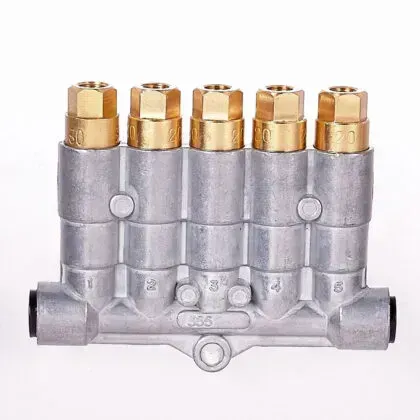 A 5-outlet 35-type body: one metering element per outlet, one fixed dose per pressure cycle.
A volumetric distributor puts a small metering chamber behind each outlet. When pressure rises past the distributor's action guarantee pressure, each chamber discharges its fixed volume to its point, refilling when the pump vents the line. Distribution is set by machined geometry, not line resistance, so a long run and a short run get their doses independently. More on the mechanism: how volumetric distributors work.
This architecture covers the 35-type and the RH3. The 35-type: 2-, 3-, 5-, and 6-outlet bodies, each outlet configurable 0.1–0.6 ml per cycle, oil action guarantee pressure 12–15 kgf/cm², viscosity window 20–500 cSt. The RH3 inspecting volume distributor refines this with an umbrella-shaped double-sided valve, finer 0.03–0.4 ml doses, and a signal pin extending while measuring and retracting on discharge, cycling visible without instruments. RH3: 2-, 3-, 4-, and 5-outlet, combinable for six-plus points.
Volumetric systems dose intermittently. Between cycles nothing flows, which suits total-loss oil lubrication on machine tools well: fresh oil arrives in small metered amounts, on a fixed schedule.
Progressive: one line, pistons in strict sequence
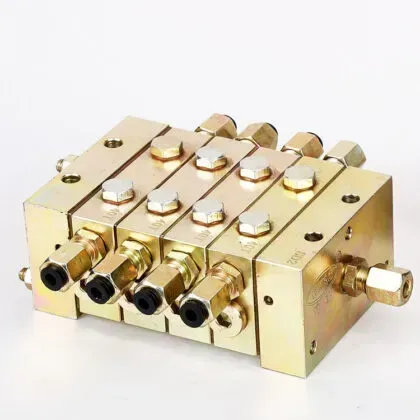 An SD-series progressive block: start and end blocks sandwiching the metering wafers.
A progressive distributor stacks piston blocks so the pistons fire only in order. Lubricant from a single supply line moves the first piston through its stroke, routing flow to the second, and so on. No piston fires twice until every piston has fired once, so every point gets its metered volume before the cycle repeats. There's no action-pressure threshold or vent phase. It advances whenever the pump supplies it.
AMAG's progressive line is the SD series of block-type grease distributors: a start block, an end block, 3–10 middle wafers serving 1–20 points. Dose per cycle by wafer size: 0.08–0.24 ml SD1, 0.16–0.40 ml SD2 (both single outlet), 0.40–2.40 ml double-outlet SD3. Minimum starting pressure 1.4 MPa, maximum 25 MPa, which is why progressive is default for grease on heavily loaded machinery. The SD2 distributor, mid-range, fits injection moulding clamps.
The sequential mechanism has a side benefit that's arguably its best feature. Since every piston must cycle for any to cycle again, watching one tells you about all. A mechanical indicator pin gives a visual check; an electric micro-switch turns each cycle into a pulse a PLC can count.
Resist-type: continuous flow, divided in ratio
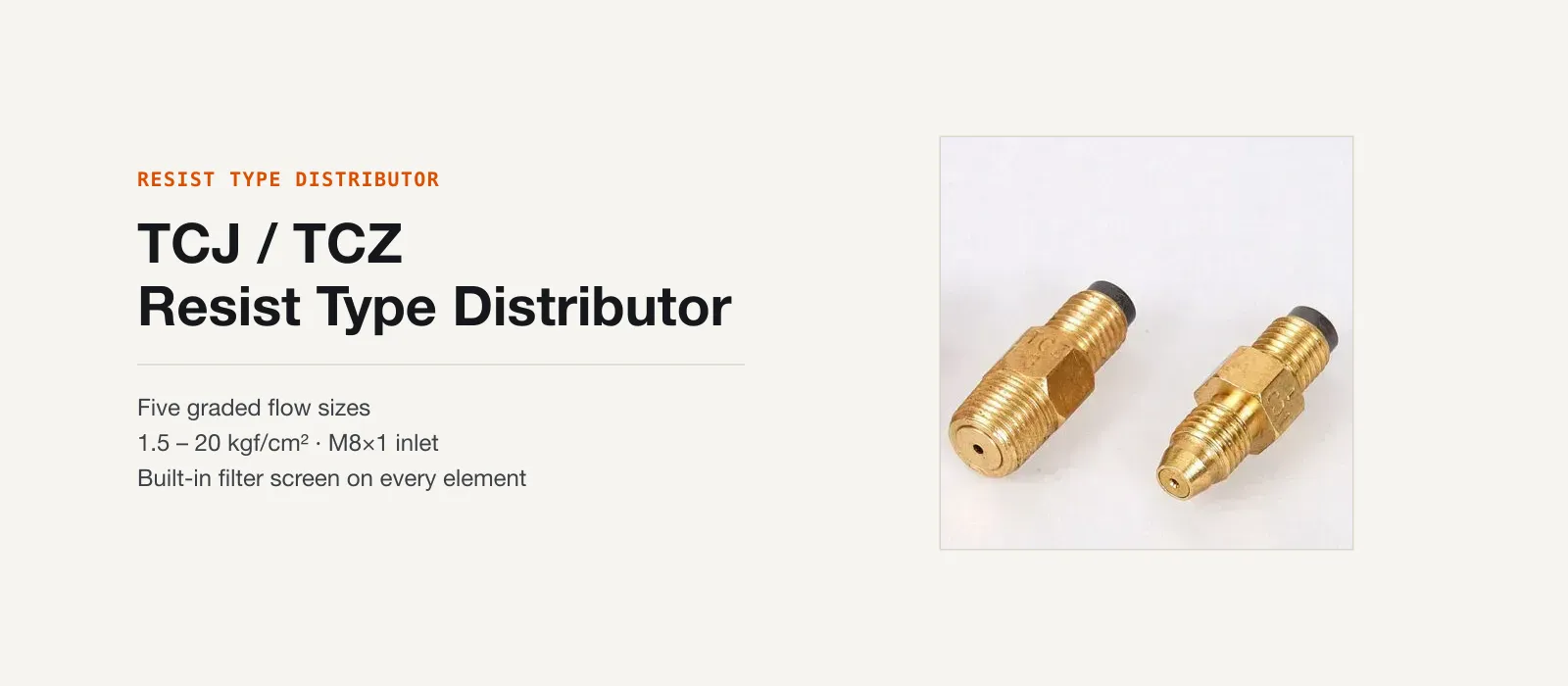
The third architecture gives up on discrete doses entirely. A resist-type (restriction) distributor places a calibrated damping hole in front of each point, behind a filter screen and a single-side valve. Oil flows continuously while the pump runs, and the restrictions divide it proportionally: a larger flow-rate unit gets a larger share. Nothing cycles or measures: matched restrictions in parallel.
AMAG's TCJ and TCZ resist-type distributors come in five flow-rate grades, 1 through 16, operating 1.5–20 kgf/cm². TCJ and TCZ cover the same five grades; the letter is an outlet-thread choice, not a flow split: TCJ takes M8×1, TCZ takes R1/8. The 20–50 cSt viscosity window is much narrower than the volumetric families, since restriction flow depends on viscosity and ratios drift between cold and warm running. Resist-type suits lightly loaded points running continuously on thin oil, needing a steady small feed rather than an exact milliliter count.
The lens that actually decides it: failure behaviour
Brochures compare architectures on precision. In the field, what matters is what happens when a line or point blocks. On an unattended machine, an unnoticed failure is the dangerous kind.
In a volumetric system, a blocked point starves silently. Its metering element can't discharge, but every other outlet keeps dosing normally, the pump still reaches action pressure, and the pressure switch stays happy, until the starved point shows wear. Inspection is the mitigation: the RH3's signal pin makes cycling visible at a glance, and periodic oil-film checks are part of owning the system.
In a progressive system, one blocked point stalls the entire distributor, since the sequence can't advance past a piston that can't complete its stroke. Every point stops receiving grease at once. That sounds worse, but it's honest: the micro-switch stops pulsing, the PLC misses its cycle count, and the machine can alarm within minutes, not weeks.
Diagnosis: crack fittings one at a time while the pump runs; flow resumes the moment you open the blocked line. Wiring and alarm logic: progressive distributors and PLC monitoring.
In a resist-type system, a blocked point stops taking its share while flow continues elsewhere, unannounced. Monitoring is limited to what the pump can tell you: fine for light, continuously fed points, not for critical, heavily loaded ones.
Side by side
| Volumetric | Progressive | Resist-type | |
|---|---|---|---|
| How lubricant divides | Fixed chamber volume per outlet, discharged each pressure cycle | Metered piston strokes in strict mechanical sequence from one line | Continuous flow split in ratio by calibrated damping holes |
| Dose control | 35-type: 0.1–0.6 ml per outlet per cycle, individually configurable; RH3: 0.03–0.4 ml | SD1 0.08–0.24 ml, SD2 0.16–0.40 ml, SD3 0.40–2.40 ml per cycle per point | Proportional share only, set by flow-rate grade 1/2/4/8/16 |
| Blocked point | Starves silently; rest of system unaffected | Whole distributor stalls; loud, detectable failure | Blocked point starves; flow continues elsewhere unannounced |
| Monitoring | Pressure switch at pump confirms action pressure; RH3 signal pin for visual cycling | Indicator pin; electric micro-switch gives PLC a countable pulse per cycle | Pump-side pressure and level only; per-point checks are manual |
| Typical lubricant | Oil 20–500 cSt; 00#/000# grease variants (30–40 kgf/cm² action) | Grease, NLGI 000/00 in centralised systems | Oil 20–50 cSt |
| AMAG family | 35-type (2/3/5/6 outlets); RH3 (2/3/4/5 outlets, combinable in series) | SD1/SD2/SD3 blocks, 1–20 points, 1.4 MPa start, 25 MPa max | TCJ / TCZ, 5 grades each, 1.5–20 kgf/cm² |
Choosing by machine and duty
For CNC machine tools with oil-lubricated ways, ballscrews, and guide trucks dosed on a timer, volumetric is the natural fit: the 35-type where 0.1–0.6 ml doses match the points, the RH3 where lighter points want doses down to 0.03 ml, or where the signal pin's visual confirmation matters on a hard-to-instrument machine.
For grease-lubricated heavy machinery, injection moulding machines, and presses, progressive is usually right, not only for the 25 MPa capability. Semi-fluid 000/00 grease won't show a film you can inspect, so the micro-switch's confirmation that every point cycled is worth a lot where a seized clamp is an expensive day.
For light, continuously running oil points on smaller machinery, resist-type keeps the hardware minimal, provided the oil stays in the 20–50 cSt window and no point is critical enough to demand individual proof of delivery.
Machines that mix needs can mix architectures: the TZ pump, orderable with or without a pressure take-off, works with both volumetric and resist-type distribution, and the GM pump's 35 kgf/cm² rated output sits inside the 30–40 kgf/cm² grease action pressure window of the 35-type distributors, which is why the two are supplied as a matched pairing.
Three things decide it: what lubricant the machine needs, how it's duty-cycled, and how much visibility you want into failures. Answer those and the architecture usually follows. For a second pair of eyes, describe the machine in our system design worksheet and we'll work through it with you.
Related articles
Technical Guides
CNC Lubrication System Layout: Where the Pump, Lines and Distributors Go
Sizing tells you what to buy; layout decides if you can maintain it. Pump placement, trunk and branch routing, and where distributors must sit.
Technical Guides
When a Centralised Grease System Can Run NLGI 2
NLGI 2 belongs on a 30 MPa progressive circuit, not a GM or 35-type reservoir. The three grease pressure classes decide the grade, and what mixing them costs.
Technical Guides
How to Lubricate an Injection Moulding Machine: Tie Bars, Toggles, and Platens
Oil or semi-fluid grease on the clamp, why those points want pressure-volumetric metering, and the AMAG pump pairings that match a 35-type action window.