Distributors & Metering Blocks for CNC Machines
Metering blocks that split one pump line into measured deliveries at each lubrication point. Volumetric and inspecting types for oil, progressive and resist-type proportioning for grease, in fixed and adjustable outlet counts.
11 families · Ships pan-India
How to choose
Three metering architectures, one job
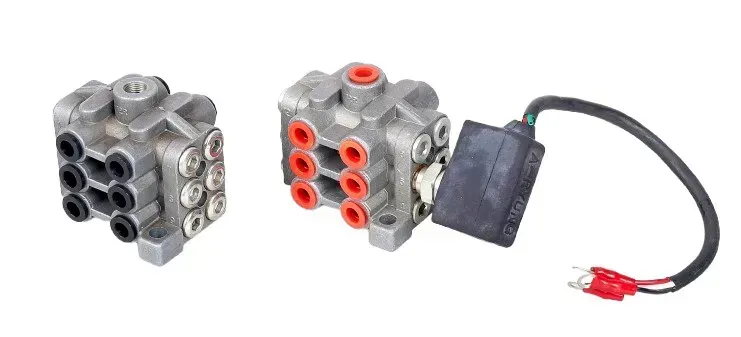
A lubrication pump pushes oil or grease into a line under pressure; it has no way of dividing that flow between several points. That's the distributor's job, and the catalogue covers it three different ways. Volumetric and inspecting blocks (34 Type, 35 Type, RH-2, RH3, AD, DK) meter a fixed dose per outlet on every pump cycle, working in parallel. Progressive blocks (SD Series, U-Shaped) feed their outlets strictly in sequence, so a jammed outlet stalls the whole block and can be caught downstream. Resist-type distributors (TCJ/TCZ, VK/VM, TK) have no metering action at all: they split flow proportionally through calibrated restrictions, with fewer moving parts to wear or stick.
Which architecture fits depends on the circuit: parallel volumetric blocks are the default for most CNC and injection-moulding oil circuits, progressive blocks suit larger grease circuits where a stalled point has to be detectable, and resist-type blocks suit light, continuously fed points where simplicity and low cost per outlet matter more than active metering.
Choosing among the volumetric and inspecting blocks
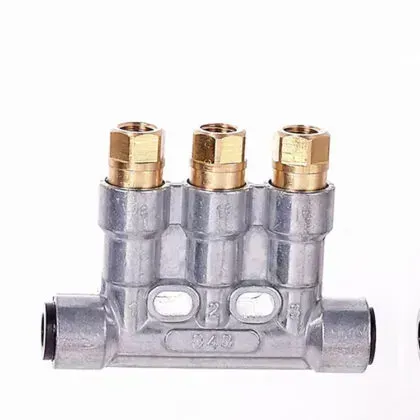
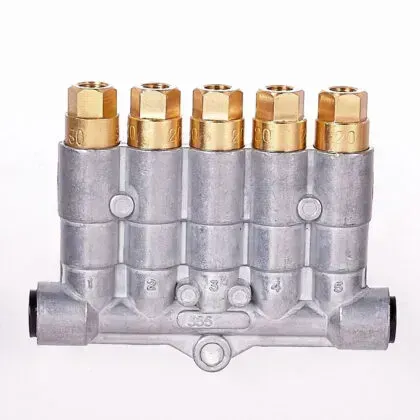
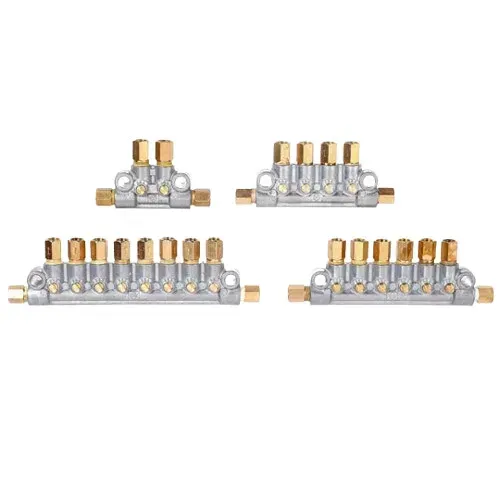
The 34 Type is the smallest of the family: 2 to 5 outlets at 0.03–0.16 ml per outlet per cycle, action guaranteed at 8–12 kgf/cm², sized for small CNC machines and light-duty multi-point oil circuits. The 35 Type steps up to 2–6 outlets at 0.1–0.6 ml per cycle and handles both oil (12–15 kgf/cm²) and NLGI 00#/000# grease (30–40 kgf/cm²), which is why it's the volumetric block most often paired with the GM and TZ pumps.
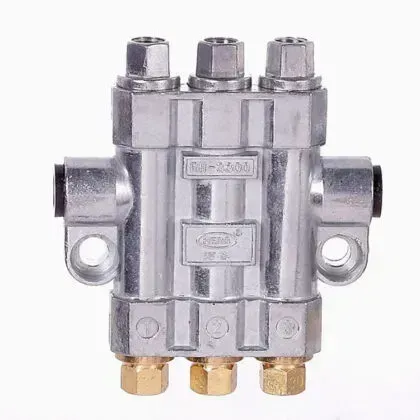
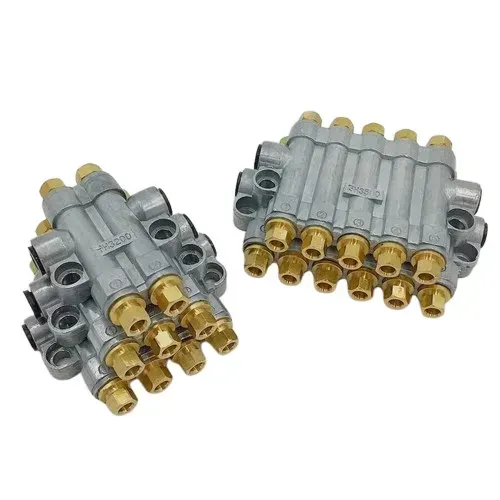
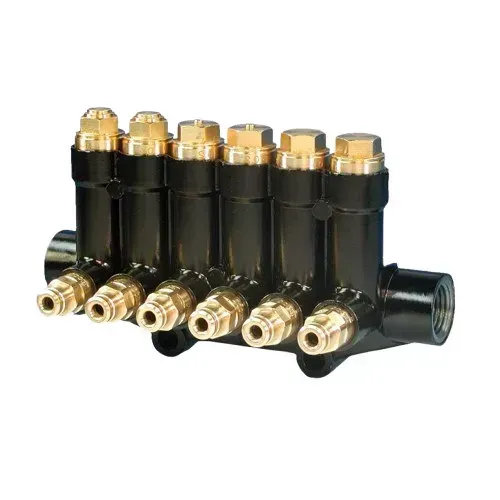
The RH-2 and RH3 add a signal pin per outlet that moves visibly when the dose is delivered: proof of lubrication rather than an assumption that the pump running means every point got its share. The RH-2 covers 2, 3 or 5 outlets at 0.03–0.3 ml per cycle; the RH3 extends that to 2, 3, 4 or 5 outlets combinable in series for higher counts, at a wider 0.03–0.4 ml dose and a broader grease pressure window of 20–50 kgf/cm².
The AD Volume Type re-bodies the RH volumetric mechanism into a compact form with 50 mm hole centres across the whole family, built for tight vehicle installations at 2.5–5.5 MPa. The DK Type Single Distributor is the odd one out: one metered outlet in one small body, for a lubrication point a multi-outlet block simply can't reach, in either oil or grease (G-suffix) builds, and combinable with a TH type connector where a block output needs to be split further.
Progressive blocks for larger, sequenced grease circuits
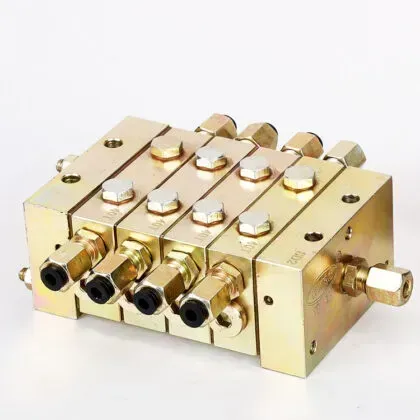
The SD Series (SD1, SD2, SD3) is a block-type progressive distributor feeding 1 to 20 points strictly in sequence at up to 25 MPa, built from 3 to 10 working blocks that can be sized to the point count. The U-Shaped Integrated Progressive Distributor takes a different construction: one solid body feeding 4, 6, 8, 10 or 12 points at a fixed 0.3 ml per cycle each, rated 15 MPa, with no blocks to assemble and no joints between them to leak. Its M models add a cycling feedback switch, and it's rated for NLGI 000# to 1# grease across a −20 °C to +80 °C range. Choose the SD block where the point count needs to flex block-by-block; choose the U-Shaped body where a fixed point count and one-piece construction matter more than field-adjustability.
Resist-type distributors: no moving parts
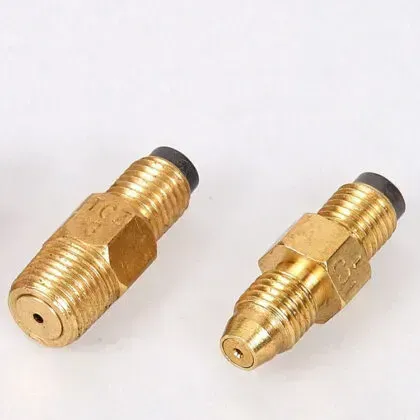
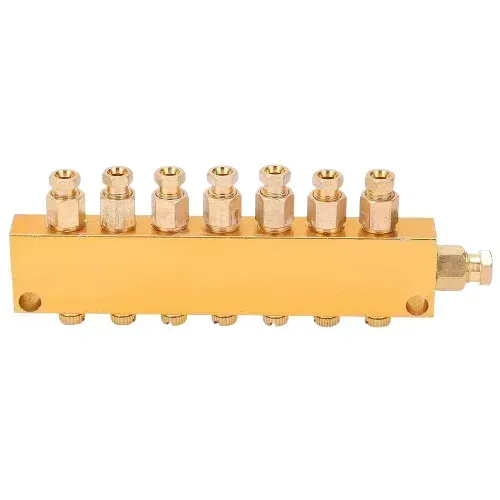
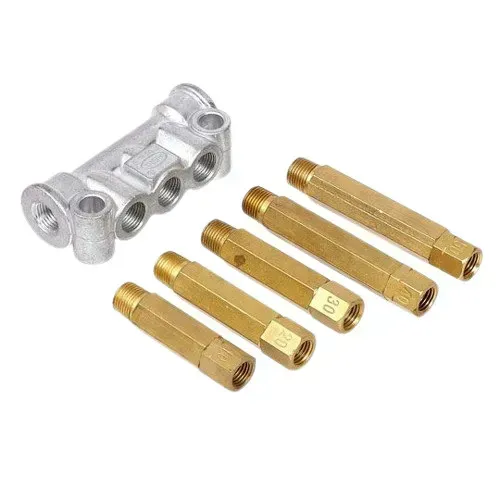
The VK/VM series splits flow between 2, 4, 6 or 8 outlets purely by the size of a calibrated restriction: no moving parts to stick or wear, and the lowest cost per lubrication point in the range, running Ø4 tube on M8×1 throughout. The TCJ/TCZ series offers five graded flow sizes (1 · 2 · 4 · 8 · 16) with a built-in filter screen, working 1.5–20 kgf/cm² across a 20–50 cSt oil viscosity window, a fit for light, continuously fed points rather than heavy dosed ones. The TK Type sits between resist-type simplicity and volumetric flexibility: 2 to 10 outlets, each with an adjustable needle set on site, so the proportion between points can be tuned at commissioning and re-set later without changing parts.
Tell us the machine, the number of lube points and the interval. We will name the model and the matching distributors.
WhatsApp an engineer+91 73976 31796Replacing an existing distributor system?
Whether the existing machine uses resistance, volumetric or progressive distribution, AMAG can configure the pump, distributor, tubing and fittings as one replacement package for the required lubrication output.
Which distributor for which job
A quick reference across the eleven distributor blocks in the catalogue, grounded in their published outlet counts, dose and pressure specs.
| Use case | Best for | Outlets / points | Dose & pressure |
|---|---|---|---|
| 34 Type | Small CNC machines and light-duty multi-point oil circuits | 2, 3, 4 or 5 outlets | 0.03–0.16 ml/cycle, 8–12 kgf/cm², oil only |
| 35 Type | General-purpose volumetric metering for oil or grease, paired with GM/TZ pumps | 2, 3, 5 or 6 outlets | 0.1–0.6 ml/cycle; oil 12–15, grease 30–40 kgf/cm² |
| RH-2 | Proof-of-delivery on smaller point counts | 2, 3 or 5 outlets | 0.03–0.3 ml/cycle, action guaranteed 8–12 kgf/cm², signal pin per outlet |
| RH3 | Proof-of-delivery on larger point counts, combinable for more outlets | 2, 3, 4 or 5 outlets, combinable in series | 0.03–0.4 ml/cycle; oil 12–15, grease 20–50 kgf/cm² |
| AD Volume Type | Tight vehicle installations needing a compact volumetric block | 2, 3, 4 or 6 outlets | 0.1, 0.2 or 0.4 cc/cycle, 2.5–5.5 MPa |
| DK Single | One lubrication point a multi-outlet block can't reach | 1 outlet | 0.05–0.5 ml/cycle; oil 12–15, grease 30–40 kgf/cm² |
| SD Series | Larger grease circuits needing points fed strictly in sequence | 1 to 20 points across 3–10 working blocks | Up to 25 MPa, progressive |
| U-Shaped Progressive | Fixed point counts wanting one-piece construction, no block joints | 4, 6, 8, 10 or 12 points | Fixed 0.3 ml/cycle per point, 15 MPa; M models add cycling feedback |
| TCJ / TCZ | Light, continuously fed points needing a proportional split | Five flow grades (1 · 2 · 4 · 8 · 16) | 1.5–20 kgf/cm², 20–50 cSt oil, built-in filter screen |
| VK / VM | Lowest cost per point, no moving parts to stick or wear | 2, 4, 6 or 8 outlets | Fixed ratio by restriction size, Ø4 tube on M8×1 |
| TK Adjustable | Circuits needing the proportion re-tuned after commissioning | 2 to 10 outlets | Adjustable needle per outlet, Ø6 tube on M10×1 |
DistributorsLubrication Systems11
Frequently asked questions
What's the difference between a volumetric and an inspecting distributor?
A volumetric block like the 34 Type or 35 Type meters a fixed dose per outlet on trust: the pump ran, the dose is assumed delivered. An inspecting block like the RH-2 or RH3 adds a signal pin per outlet that visibly moves when the dose actually goes out, giving mechanical proof rather than an assumption.
What's the difference between the RH-2 and RH3 distributors?
Both are inspecting volumetric blocks with a signal pin per outlet. The RH3 is the newer design: it's combinable in series for higher outlet counts and covers a wider grease pressure window (20–50 kgf/cm² versus the RH-2's 8–12 kgf/cm² action-guarantee range).
When do I need a progressive distributor instead of a volumetric one?
Choose a progressive block (the SD Series or the U-Shaped Integrated Distributor) when points need to be fed strictly in sequence, typically on larger grease circuits, or when a stalled point needs to be detectable downstream. Volumetric blocks meter each outlet independently in parallel, which suits most CNC and injection-moulding oil circuits.
What is a resist-type distributor and why choose one?
Resist-type distributors (TCJ/TCZ, VK/VM, TK) have no metering action or moving parts: they split flow proportionally through a calibrated restriction. The VK/VM series is the lowest-cost-per-point option in the catalogue for that reason; the TK Type trades some of that simplicity for an adjustable needle per outlet so the split can be re-tuned after commissioning.
Can I combine multiple distributor blocks for more outlets?
Yes: the RH3 inspecting distributor is specifically built to combine in series (2, 3, 4 or 5 outlets per block) for higher total counts, and the SD Series progressive distributor is built from 3 to 10 working blocks sized to the point count.
What is the DK Type distributor used for?
The DK Type is a single-outlet distributor for one lubrication point that a multi-outlet block can't reach: fitted directly at the point, available in oil and grease (G-suffix) builds, and combinable with a TH type connector where the output needs splitting further.
Related reading
How positive-displacement metering guarantees each lube point a fixed dose per cycle, explained through the 35-type pressurised volume distributor.
How volumetric, progressive, and resist-type distributors divide lubricant among points, and how each architecture behaves when a line blocks.
The RH3 distributor's signal pin gives per-point mechanical proof that lubricant actually moved. How it works, how to read it, and where its limits are.
How series-progressive distributors and a simple PLC pattern turn lubrication from an act of faith into a checkable interlock, with SD-series details.