Technical Guides
How to Read the RH3 Distributor Signal Pin for Proof of Lubrication
AMAG Team7 min read
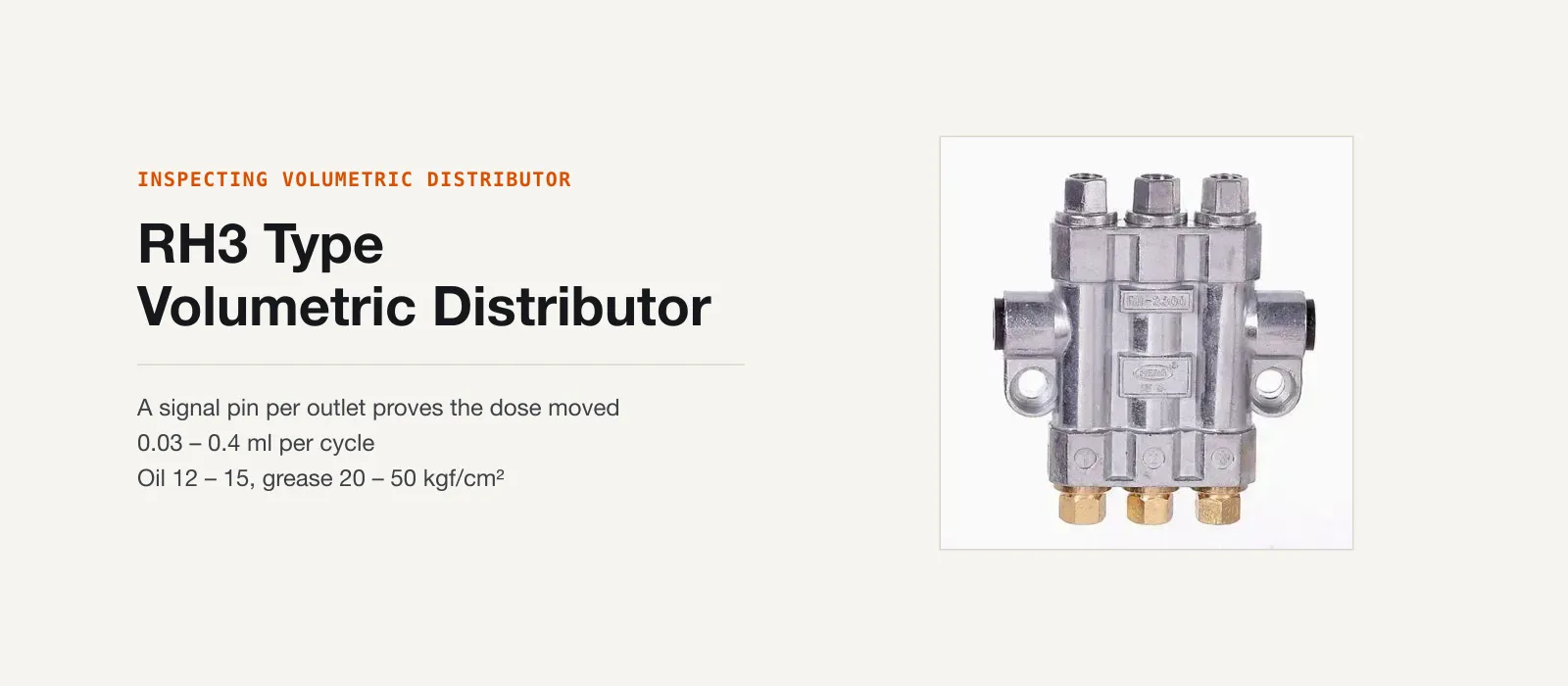
Centralised lubrication has an uncomfortable failure mode: it fails silently. The pump runs on schedule, the gauge climbs to pressure just like it did at commissioning, and every visible sign says the system is alive. Meanwhile a crushed feed tube behind a cover, or a metering valve jammed by a grain of debris, can starve one lubrication point for months.
Nobody finds out until a way scars or a ballscrew starts to whine, and by then the damage is already priced in.
AMAG's RH3 Type Inspecting Volume Distributor attacks that problem with a built-in mechanical signal pin that moves with the metering stroke. It's a simple idea, but it changes what an operator can verify on a walkaround. Here's what the pin actually proves, what it doesn't, and how to build a routine around it.
Why the pressure gauge can't tell you
In a volumetric oil system, the pump pressurises a main line on a schedule, and each distributor meters a fixed dose from each outlet once the line reaches action pressure (full mechanism in how volumetric distributors work). The gauge at the pump reports on the main line, and only the main line.
The gauge confirms only that the pump built pressure and the main line held it. It says nothing about any individual outlet. If one branch tube is pinched flat where a guard was reinstalled over it, the main line still reaches pressure on time.
If one metering valve is gummed solid, the other outlets still fire and the gauge trace looks identical. Even total oil consumption barely moves: losing one point out of ten changes reservoir draw-down so little you'll never spot it on the sight glass.
In other words, the pump running and the bearing actually receiving oil are two different facts. The gauge only confirms the first one.
A mechanical heartbeat you can see
The RH3's answer is to make the metering stroke itself visible. Each distributor carries a built-in signal pin that extends during the measuring stroke and retracts during discharge. It isn't a lamp wired to the pump contactor, and it isn't an inference from line pressure. The pin is driven by the metering mechanism itself, so its motion is direct evidence the valve behind it physically moved through its cycle: it took in a measured volume, then pushed it out.
Plenty of "system running" indicators really just mean "power applied." The RH3 pin is different. It means this distributor measured and discharged. Watch it extend and retract during a lube cycle, and you're watching the dose actually happen.
The distributor behind the pin is a second-generation design, an improvement over the earlier RH2, with an umbrella-shaped double-sided valve chosen for metering accuracy. Discharge per outlet ranges from 0.03 to 0.4 ml per cycle, compared with the 35-type pressurised volume distributor's 0.1–0.6 ml per cycle range. The RH3's lower doses suit light points: small linear guides, light-duty bushings, and compact machines where even 0.1 ml per cycle is already more oil than the point needs, with the excess ending up in the chip pan.
Model coverage: 2-, 3-, 4-, and 5-outlet versions (the RH-32XX, RH-33XX, RH-34XX, and RH-35XX families), with units combining in series for 6, 7, or more points. On oil, action guarantee pressure is 12–15 kgf/cm² (roughly the same figure in bar), with recommended viscosity of 20–500 cSt. For grease, two dedicated variants, the low-pressure RH-35XX(G) and high-pressure RH-35XX(GH), cover action pressures from 20 to 50 kgf/cm² on 00# or 000# semi-fluid grease.
Turning the pin into a routine
A signal pin only earns its keep if somebody looks at it. Building the looking into a procedure costs a few minutes.
Command a lube cycle (most controls have a manual lube function), or catch the next scheduled one. While the system pressurises and discharges, walk the distributors and watch each pin. On a healthy unit it extends as the distributor measures, then retracts as it discharges. One glance per distributor confirms that outlet's metering element completed its stroke.
Then put it on paper. Add a line to the operator's daily sheet, "all lube pins cycled during morning lube: Y/N," next to whatever coolant-concentration or air-pressure checks already live there.
A check that isn't recorded quietly stops happening. The pin's value is in its regularity: checked monthly, it protects you for a month at a time. Checked daily, it narrows any failure window to a single shift.
Think about visibility at installation time, too. Mount distributors where the pins can be seen without pulling a guard. A distributor bolted face-in behind sheet metal has a signal pin that's effectively useless, even though it's still moving. On a new system, treat whether the operator can see the pin from the floor as a real routing constraint, alongside the other layout decisions that determine what you can check later.
Reading a pin that isn't behaving
The pin gives you two useful failure signatures, and they point in different directions.
A pin that never moves during a commanded cycle means the metering stroke never happened. Either the distributor never saw action pressure (check the gauge, the main line to that unit, and whether other distributors on the same line cycled), or the metering valve is jammed. A jam usually traces back to contamination: a dirty top-up or an open reservoir lid sending grit downstream to lodge in the valve.
A pin that sticks extended and stays there means the distributor measured but could not discharge. The dose is trapped, which points downstream of the distributor: a blocked, kinked, or crushed outlet tube between the distributor and the bearing.
Either way, you have per-point evidence and a direction to search, rather than just a healthy gauge and a guess. The full fault tree, including what to do when pressure never builds or builds suspiciously fast, is in our centralised lubrication troubleshooting guide.
Where the pin honestly isn't enough
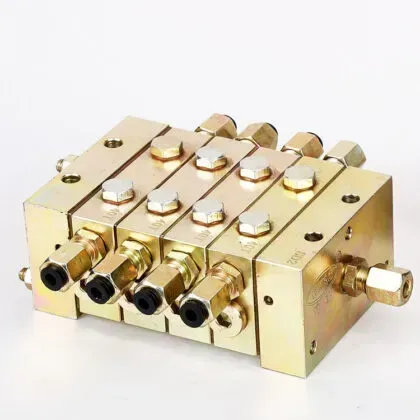 A progressive block with micro-switch feedback reports every cycle electrically, which matters when nobody walks the machine.
Here is the limit, stated plainly: a mechanical pin needs a human looking at it. On an attended day shift, that's a fine bargain, since the operator is already standing there and the check costs nothing. On a lights-out cell, a third-shift machine nobody walks past, or equipment installed somewhere people rarely go, a pin can signal a failure faithfully for weeks to an empty room.
When nobody walks the machine, the confirmation needs to arrive as an electrical signal instead of a visual one. That's the case for series-progressive distributors fitted with micro-switch feedback, where the control system counts lubrication cycles and raises an alarm when an expected cycle doesn't complete. We cover that architecture, and the PLC logic pattern behind it, in progressive distributors and PLC monitoring.
The two aren't really rivals. They suit different staffing realities. The RH3 gives volumetric oil systems visible per-point proof, but it needs eyes on it. Progressive-with-micro-switch gives machine-readable proof instead, at the cost of a different architecture. Plenty of shops run both, on different machines.
The five-minute habit that catches the quiet failure
Most lubrication failures don't announce themselves; they accumulate. The RH3's signal pin converts an invisible process into a visible one, and a daily glance at a row of pins is about the cheapest insurance a machine gets. If some of your machines have lube points you can't afford to lose, and you can't currently prove they're being fed, it's worth a conversation about where an inspecting distributor fits. Get in touch and we'll help you work through it.
Related articles
Technical Guides
CNC Lubrication System Layout: Where the Pump, Lines and Distributors Go
Sizing tells you what to buy; layout decides if you can maintain it. Pump placement, trunk and branch routing, and where distributors must sit.
Technical Guides
When a Centralised Grease System Can Run NLGI 2
NLGI 2 belongs on a 30 MPa progressive circuit, not a GM or 35-type reservoir. The three grease pressure classes decide the grade, and what mixing them costs.
Technical Guides
How to Lubricate an Injection Moulding Machine: Tie Bars, Toggles, and Platens
Oil or semi-fluid grease on the clamp, why those points want pressure-volumetric metering, and the AMAG pump pairings that match a 35-type action window.