Buying Guide
How to Choose the Right Lubrication System for Your Equipment
AMAG Team5 min read

Most buyers land here already knowing roughly what a centralised lubrication system does. What they need is faster: which family, for this machine, today. This guide is five questions, not a catalogue read-through. Answer them in order and you'll have a distributor and pump family before you'd have finished reading a full spec comparison. For the mechanics behind each answer, our architecture comparison and complete lubrication guide go deep; this post exists to get you to the right one of those, fast.
Question 1: Oil or grease?
Look at what's actually on the machine. Spindle bearings, linear ways, ballscrew nuts and tool changers run on oil, typically ISO VG 32–220 depending on the point, within the 20–500 cst window every AMAG oil distributor accepts. Platens, tie bars, clamp mechanisms and heavy pivots run on grease, usually NLGI 000# or 00# in a metered circuit, up to NLGI 2# only where a progressive pump pushes it at full pressure rather than through a small metering chamber. Mixed machines exist, a CNC centre with grease-packed bearings alongside oiled ways, and just need two circuits, not one compromise. Full grade reasoning: machine tool oil viscosity guide and when centralised grease can run NLGI 2.
Question 2: How many points, really?
Count them on the actual machine, not the drawing; points hide behind way covers. The number narrows your distributor fast:
| Points | Distributor |
|---|---|
| 2–5 | 34-type, oil only, 0.03–0.16 ml/cycle |
| 2–6 | 35-type, oil or grease, 0.1–0.6 ml/cycle |
| 2–5 (combinable for 6+) | RH3, finer 0.03–0.4 ml doses, visual signal pin |
| 1–20, grease | SD-series, 3–10 wafer blocks, up to 25 MPa |
| 4–12, grease | U-shaped, fixed 0.3 ml/point |
| 1 remote point | DK single distributor, 0.05–0.5 ml |
If you'd rather work from a formula than a lookup table, the worked sizing example walks a real 17-point machine through point count, dose, and refill interval end to end.
Question 3: Do you need to see a dry point, or just avoid a silent one?
This is the question buyers skip and regret skipping. Every metering architecture divides lubricant differently, and that difference decides what happens when a line blocks:
- Volumetric (34-type, 35-type, RH3): each outlet doses independently, so a blocked point starves silently while the pump still reaches pressure and every other outlet keeps running fine. The RH3's signal pin is the one exception, since it extends and retracts with every cycle, so a stuck pin flags the fault at a glance.
- Progressive (SD-series, U-shaped): every piston has to fire in sequence, so one blocked outlet stalls the whole distributor. That's a louder failure, but it's an honest one, an alarm condition a PLC can catch in minutes rather than a wear pattern discovered weeks later.
- Resist-type (TCJ/TCZ): flow splits continuously by calibrated restriction, no cycling, no per-point confirmation at all.
If a starved point is expensive to discover late (an unattended machine, a critical bearing), pick progressive or RH3. If the points are light and forgiving, resist-type or plain volumetric costs less hardware. The full mechanism, including a side-by-side failure-behaviour table, is in volumetric, progressive, or resist-type.
Question 4: What pressure class does the duty call for?
Oil circuits on the 35-type and RH3 need 12–15 kgf/cm² to guarantee action; the lighter 34-type needs 8–12. Grease through a volumetric 35-type needs 30–40 kgf/cm², which is why the GM pump is built to a 35 kgf/cm² rated output specifically to sit inside that window. Heavier grease duty on a progressive circuit runs 1.4–25 MPa through the SD-series, or up to 30 MPa on the piston-driven ZJ pump for engineering and mobile plant. A resist-type oil circuit only needs 1.5–20 kgf/cm², the trade-off for giving up metered doses.
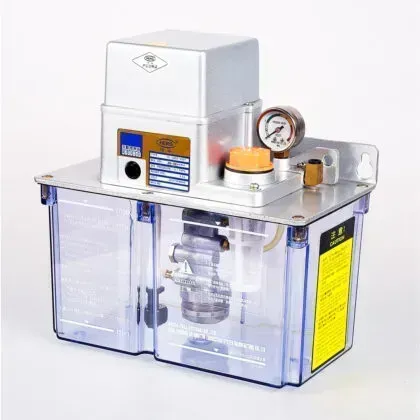 The HL: 15 kgf/cm² rated, 25 kgf/cm² max, 110–260 ml/min depending on model, the pump behind most oiled-way CNC circuits.
Question 5: Is there mains power at the lube station?
Most CNC and injection-moulding circuits run motor-driven (TZ, HL, GM), because a motor holds a timed schedule across a shift with nobody touching it. No power run to the point, a single remote bearing, or a retrofit on an older machine? A hand-lever pump like the NKHY/PH needs nothing but a hand. Vehicle and mobile plant has its own answer: the AP grease pump runs directly off a 12 V or 24 V chassis supply.
Two worked answers
A five-point CNC machining centre, oiled ways and ballscrews, standard shift operation. Question 1: oil. Question 2: 5 points → 35-type. Question 3: no unattended-machine risk, so a plain 35-type is fine. Question 4: 12–15 kgf/cm², well within the TZ pump's 15 kgf/cm² rating. Question 5: mains available. Result: 35-type distributor + TZ pump, the most common CNC pairing we quote.
An injection-moulding clamp, 8 grease points on tie bars and platens, unattended overnight cycles. Question 1: grease. Question 2: 8 points → SD-series (1–20 point range). Question 3: unattended running makes a silent starve expensive, so progressive's stall-and-alarm behaviour is worth having. Question 4: grease at full progressive pressure, well inside the SD-series' 25 MPa ceiling. Question 5: mains available. Result: SD2 progressive distributor + GM pump.
Still between two options?
That's normal; the five questions narrow the field, they don't always pick one part. Send us your point count and machine type and we'll confirm the pairing, or work through the full mechanism and dose tables in the architecture comparison and the complete CNC lubrication guide. The design worksheet is the next step once you know your family: it turns point count and dose into an actual bill of materials.
Browse the full lubrication systems range or contact us with your machine and point count.
Related articles
Buying Guide
Wireless MPG Pendant vs. Wired Handwheel: Which Belongs on Your Machine
Same encoder, same signals to the control. A wireless pendant and a wired handwheel differ in reach, failure mode and habit, and wired sometimes wins.
Technical Guides
CNC Lubrication System Layout: Where the Pump, Lines and Distributors Go
Sizing tells you what to buy; layout decides if you can maintain it. Pump placement, trunk and branch routing, and where distributors must sit.
Technical Guides
When a Centralised Grease System Can Run NLGI 2
NLGI 2 belongs on a 30 MPa progressive circuit, not a GM or 35-type reservoir. The three grease pressure classes decide the grade, and what mixing them costs.