Buying Guide
Wireless MPG Pendant vs. Wired Handwheel: Which Belongs on Your Machine
AMAG Team8 min read
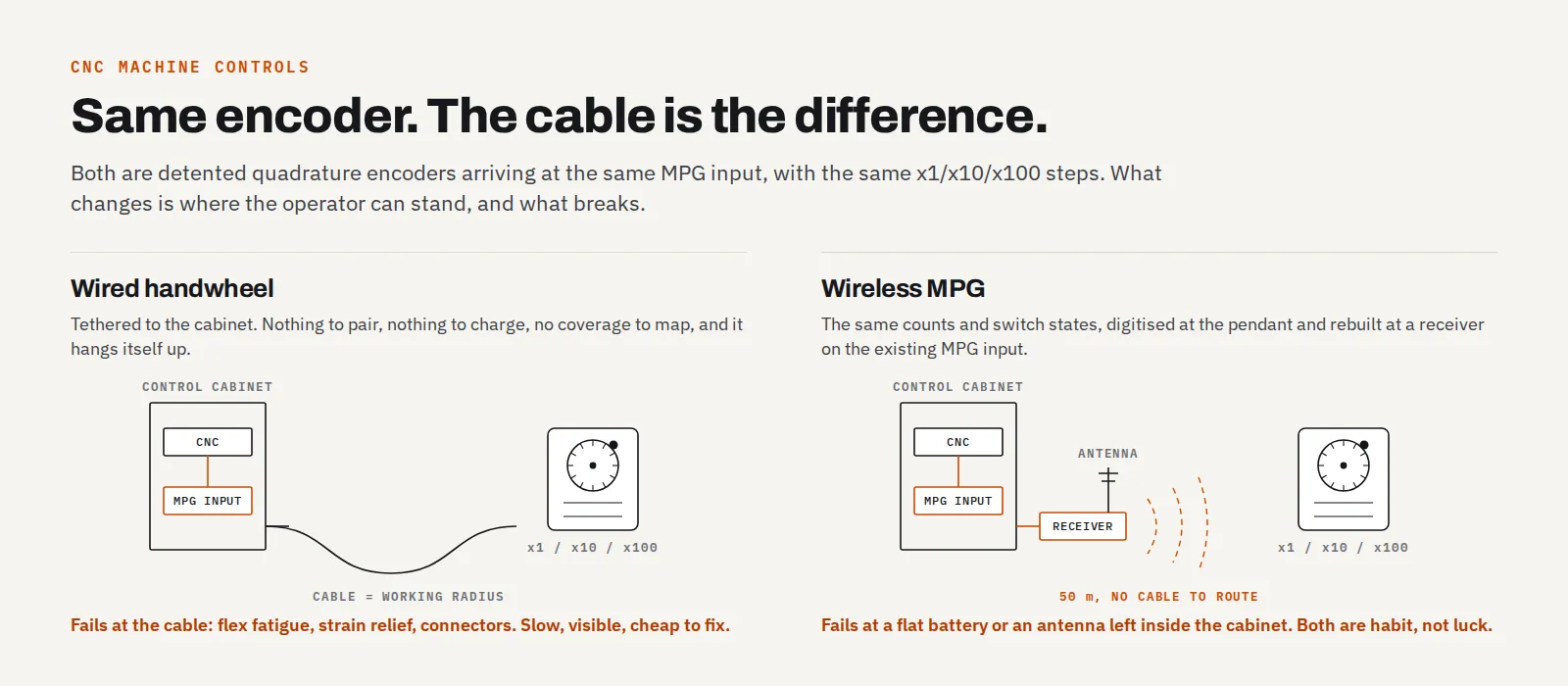
Most comparisons of this pair start from the wrong question. They treat wireless as the newer technology and wired as the thing it replaces, then list the advantages of being new. That framing produces a shopping list, not a decision.
The useful question is narrower: where does the operator need to stand? Everything that actually separates these two follows from the answer, and on plenty of machines the answer points at the wired wheel.
Start with what doesn't change
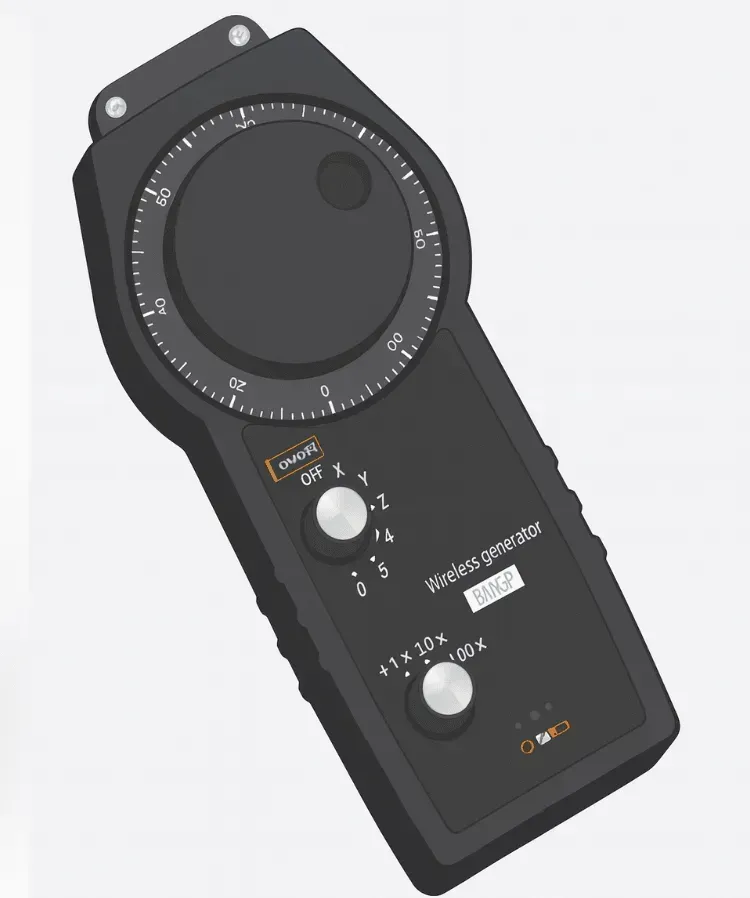
The handwheel is a detented quadrature encoder. Turning it produces two square waves offset by 90°, the control counts edges and reads the phase relationship to know direction, and a step multiplier, commonly x1, x10 and x100, decides how far one detent moves the axis. That mechanism is the same in both pendants, and we've covered it in detail in how a manual pulse generator works.
A wireless MPG digitises the wheel counts and the state of every switch at the pendant, sends them to a receiver at the electrical cabinet, and the receiver reproduces those signals in the form the control expects. To the CNC, the arrangement looks exactly like a wired handwheel.
So a few things are simply not on the table. There is no resolution difference. There is no difference in feel at the detent. There is no controller-side configuration that one needs and the other doesn't. Anybody selling you a wireless pendant on precision grounds is selling you something the wire was never costing you.
 Same wheel, same switches, same signals arriving at the control. The receiver at the cabinet is standing in for the cable.
What actually differs
Reach
A wired pendant's working radius is its cable. That's the whole specification, and on most machines it's enough. It stops being enough in three places: large-format routers where the bed runs several metres and the cable can't reach a far corner without being dragged across the material, machining centres with a fourth or fifth axis where the clearance you need to check is behind the rotary table or alongside a tombstone, and any setup where the operator ends up standing where the cable ends rather than where the work is.
The AMAG Wireless MPG covers 50 metres and five axes. The axis count matters as much as the range on multi-axis machines, where compact wired pendants run out of selector positions before they run out of cable.
The failure mode moves rather than disappears
This is the honest version of the comparison and the part most pages skip.
A wired pendant fails at the cable. Flex fatigue along the run, wear at the strain relief, a connector that loosens, and the classic: somebody puts a pallet truck across it. These are slow, visible failures, and the part is cheap.
A wireless pendant moves that failure somewhere else. The battery is one: standard AA cells, roughly 30+ days a set, no charger, no charge state. But a flat pendant mid-setup is a stopped setup unless spares live at the machine. The radio environment is the other. A machine shop is a hard place for a radio: welders are broadband emitters, servo drive cabling radiates, and a building full of steel produces multipath dead spots. None of that is fatal, and an installation that respects it is dependable, but it is real work that a cable never asked for. We wrote up the whole picture in keeping wireless controls reliable on a noisy shop floor.
Note also that the receiver's own cable run back to the MPG input takes the same strain-relief wear a wired handwheel's cable does. The wire didn't vanish; it got a lot shorter and stopped moving.
Installation
A wired pendant either lives on an existing port or needs somewhere to hang. A wireless one is a receiver wiring job: it connects into the machine's existing manual pulse generator input, with no new panel cutout, because the handwheel half never touches the panel.
The catch is in that word "existing". Confirm the MPG input is free before ordering. A machine whose input is already committed to an integrated panel wheel needs that input released first, and whether the builder will do that is a question worth asking early rather than on install day.
Habits
A wired pendant hangs where the cable ends. That is a limitation and also, quietly, a feature: it has exactly one home and it returns there by physics.
A wireless one can be set down anywhere: a bench, under a print, off a table edge. It needs a designated park spot per machine, a spare set of batteries kept at the machine, and a coverage walk at commissioning to find any dead spots before a setup does. Shops that adopt those three habits stop thinking about the pendant. Shops that don't tend to blame the tool for problems the habits would have prevented. Setup workflows with a wireless MPG goes through what changes day to day.
Side by side
| Wired handwheel | Wireless MPG | |
|---|---|---|
| Encoder and signals | Detented quadrature, x1/x10/x100 | Identical; reproduced at the receiver |
| Control sees | MPG input | The same MPG input |
| Working radius | Cable length | 50 m |
| Axes | Set by the pendant's selector | 5 |
| Installation | Existing port or a new hanging position | Receiver wired into the existing MPG input, no panel cutout |
| Consumables | None | AA batteries, roughly 30+ days a set |
| Main failure mode | Cable flex, strain relief, connectors, crush damage | Flat battery; RF dead spots from poor receiver placement |
| Commissioning extras | None | Antenna placement outside the cabinet, plus a coverage walk |
| Daily discipline | Hang it up | Park spot, power-on check, spares at the machine |
| Best at | Work done at or near the panel | Work done away from the panel |
Where wired is still the right answer
Four situations, and none of them are consolation prizes.
The operator never leaves the panel. On a compact lathe or a small mill where the work, the control and the operator are all within arm's reach, the wireless case evaporates. Reach you don't need isn't a benefit.
The MPG input is committed and the builder won't free it. Sometimes the answer is a machine-level decision that isn't yours to make. Worth establishing before anything else.
The shop won't keep consumables at machines. This sounds like a criticism of the shop and isn't. If spare AAs reliably end up in a drawer in the office, a pendant that needs them is a pendant that will be flat at the wrong moment, and you are better off with a cable.
Nobody has time for the commissioning walk. The coverage walk is 20 minutes and it's what separates a dependable wireless installation from one that drops out unpredictably. If that time genuinely isn't available, don't buy the thing that needs it.
Where wireless pays for itself
The mirror image, and the pattern is consistent: it's every job where your eyes and your hands want to be in different places.
Indicating a fixture. Reading a dial indicator off-axis isn't reading it: the needle's position against the graduations shifts with viewing angle. A wired pendant on a short leash puts you where the cable ends, craning. This is the single clearest case.
Large-format routers. A bed several metres long has corners a cable cannot reach without being dragged over the material.
Four- and five-axis work. Checking clearance behind a rotary table, at the tailstock, or alongside a tombstone, on a pendant that still has the axis selector positions to do it.
First-part proving. Standing at the cut rather than at the panel, with the feed override and the wheel in your hand.
Four things to settle before ordering
- Controller platform. Fanuc, Siemens, Mitsubishi Electric, Fagor and Heidenhain are all supported. What genuinely differs between them at integration time is covered in wireless MPG integration by controller platform.
- Is the MPG input free? As above, the question that can stop the project.
- Where the antenna goes. Outside the steel electrical cabinet, with height. A receiver inside a grounded steel box is a radio inside a shield, and it is the most common cause of "terrible range". The RF post has the full placement guidance.
- How the pendant sits in the machine's existing safety arrangement. Every machine's safety circuit is the machine builder's and the integrator's design. Raise it with them, and with us, as part of specifying the installation rather than after it arrives.
The decision in one line
If the best place to stand while jogging this machine is not at the panel, the wireless case makes itself and the rest is installation quality. If it is at the panel, a wired handwheel is the right tool and the cheaper one.
For the full specification, the Wireless MPG product page has it, and the wireless control overview covers the range. If you want to talk through a specific machine (which controller, whether the input is free, where the antenna would go), contact us and we'll work through it with you.
Frequently asked questions
Is a wireless MPG less accurate than a wired handwheel?
No. Both are detented quadrature encoders feeding the same manual pulse generator input on the control, with the same x1/x10/x100 step multipliers. A wireless pendant digitises the wheel counts and switch states and the receiver reproduces them in the form the control expects, so to the CNC the two look identical. One click is one increment either way.
Does fitting a wireless MPG mean changing the control software?
No. The receiver connects into the machine's existing manual pulse generator input, so it is a wiring job rather than a control change or a panel modification. The one thing to confirm before ordering is that the MPG input is actually free: a machine whose input is already committed to a panel-mounted wheel needs that input released first.
How long does a wireless MPG battery last?
The AMAG pendant runs on standard, user-replaceable AA batteries, roughly 30+ days on a set depending on usage. There is no charger and no charge state to manage. The only real discipline is keeping a spare set at the machine rather than in a drawer across the shop.
When is a wired handwheel still the better choice?
When the best place to stand is the panel. On a compact lathe or mill where the operator never leaves the control, reach buys nothing, and a wired pendant needs no batteries, no receiver placement and no coverage walk. It is also the answer where the machine's MPG input is committed to an integrated panel wheel that the builder will not free up.
Related articles
Buying Guide
How to Choose the Right Lubrication System for Your Equipment
A five-question decision framework for picking a distributor and pump family by point count, dose, monitoring need and pressure class, with worked examples.
Technical Guides
CNC Lubrication System Layout: Where the Pump, Lines and Distributors Go
Sizing tells you what to buy; layout decides if you can maintain it. Pump placement, trunk and branch routing, and where distributors must sit.
Technical Guides
When a Centralised Grease System Can Run NLGI 2
NLGI 2 belongs on a 30 MPa progressive circuit, not a GM or 35-type reservoir. The three grease pressure classes decide the grade, and what mixing them costs.