Technical Guides
Why Centralised Grease Systems Run on NLGI 000 and 00
AMAG Team7 min read
Ask someone to picture grease and they'll picture the stuff in a grease-gun cartridge: firm, buttery, stays where you smear it. That grease is typically NLGI 2. It's right for hand-packing a bearing and wrong for a centralised system. Loading it into one is among the costlier mistakes a maintenance department can make.
Centralised grease systems specify NLGI 000 or 00 instead: semi-fluid grades that pour more than they hold shape. That looks like a downgrade if you think of "thicker" as "better." In reality it's the property that makes the whole architecture work, and that comes down to what a centralised system actually asks the grease to do.
The NLGI scale, briefly
The NLGI scale orders greases by consistency, from semi-fluid to firm: 000, 00, 0, 1, 2, and stiffer grades beyond. The 000 end behaves almost like heavy oil. It flows under modest pressure and levels out in a container. By NLGI 2, the cartridge-and-bearing standard, the grease holds its shape and only moves when something physically pushes it.
Consistency is separate from the base oil inside the grease. A grease is oil held in a thickener matrix, and the NLGI grade describes how firm that matrix is, not how viscous the oil it releases is. Two greases of the same grade can carry very different base oils. For a centralised system, though, the consistency grade is still the first gate. It determines whether the grease can travel at all.
What a centralised system asks of grease
A hand grease gun delivers grease across a few centimetres, from cartridge to zerk, with your arm supplying the pressure. A centralised system asks for something much harder: pull grease from a reservoir, push it through metres of small-bore tubing, drive it through the internal passages and valves of metering distributors, and do all of that automatically and repeatedly, at rated pressure.
Semi-fluid grease flows through small-bore lines and metering valves at sane pressures. Critically, it won't channel in the reservoir. Firm grease is different: it doesn't flow back into the space a pump inlet has emptied. The pump eats a tunnel through the grease around its inlet, the tunnel walls hold their shape, and the pump starves with kilograms of grease sitting untouched just centimetres away.
Semi-fluid grades slump back into the void and keep the inlet fed. Push NLGI 2 down a long small-bore line instead and the physics work against you: the pressure needed to move it climbs far beyond what the design assumes, drop grows with every metre, and the far points of the system see less of what the pump is working so hard to deliver.
The pump and distributor as one system
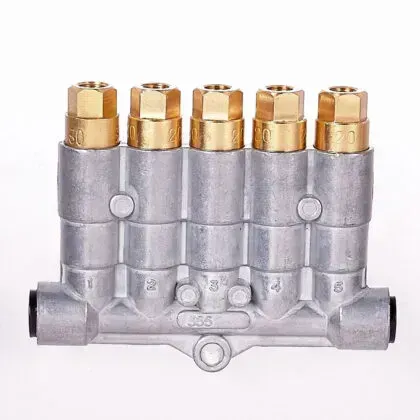 The 35-type distributor: its grease variants fire at 30–40 kgf/cm², right where the GM pump delivers.
Grade choice is only half the story. A centralised grease system also depends on the pump and its distributors agreeing on pressure, and the numbers on the two datasheets have to match up.
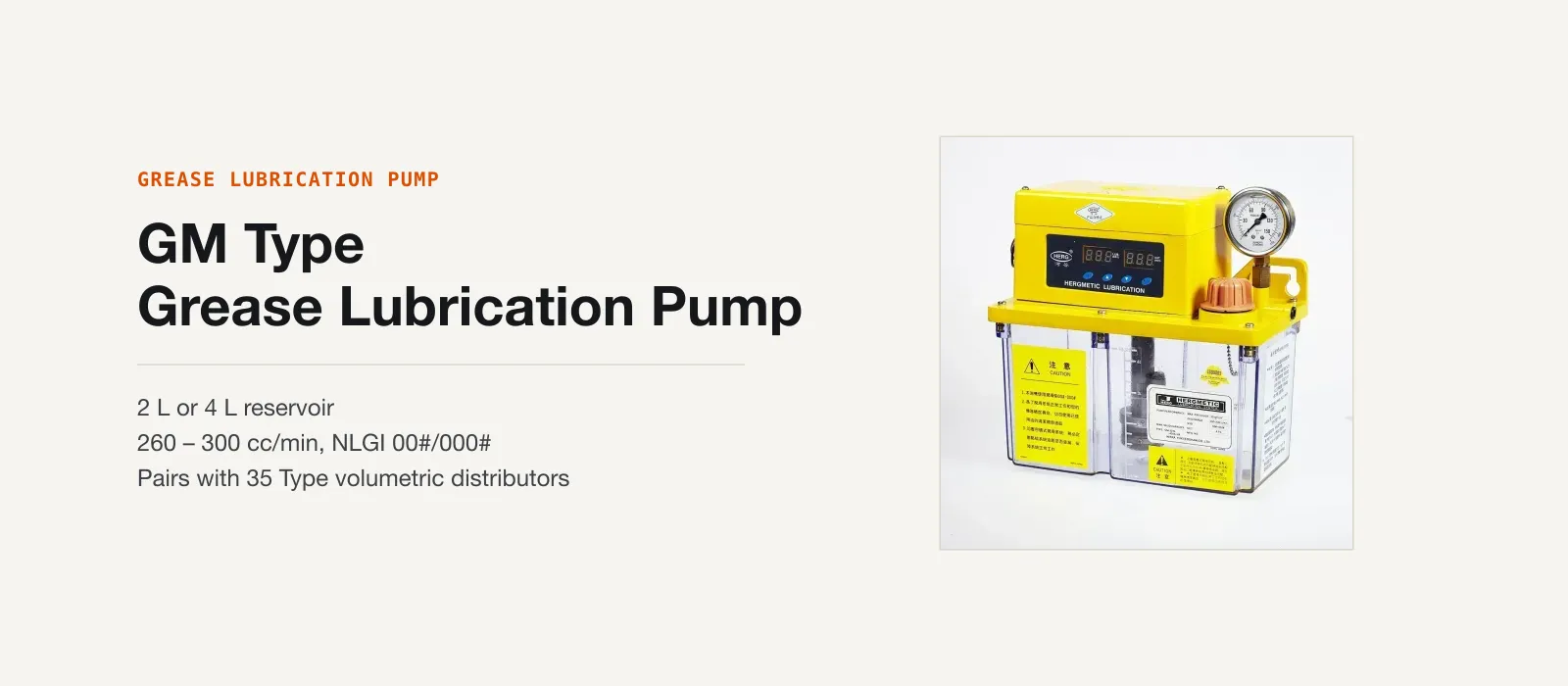
The GM type motor-driven grease pump is rated for NLGI 000# or 00# grease and delivers a rated output pressure of 35 kgf/cm². (If kgf/cm² is unfamiliar, it's roughly equivalent to bar: 1 kgf/cm² is about 0.98 bar, so read 35 kgf/cm² as roughly 35 bar.) The 35-type pressurised volume distributor runs on the same 00#/000# grades and operates on the pressurised volume principle: it injects its metered dose when system pressure rises and refills when pressure drops. For grease service, its action guarantee pressure (the pressure at which every outlet is guaranteed to fire) is 30–40 kgf/cm².
Put those numbers side by side and the pairing makes sense. The pump's 35 kgf/cm² output lands right inside the distributor's 30–40 kgf/cm² action window, high enough above the 30 kgf/cm² floor that every distributor fires even after line losses take their share. The GM pump's built-in pressure switch acts at 30 kgf/cm², the bottom of that window, so crossing 30 kgf/cm² tells the control system firing conditions were genuinely reached, not just that the pump is running.
The rest of the GM pump's design follows the same logic: a 2 L or 4 L reservoir, a 24 VDC grease level switch so an empty reservoir alarms instead of running the pump dry, and PLC-compatible terminals for both switches. Discharge is 260 cc/min at 50 Hz or 300 cc/min at 60 Hz, setting how fast the system builds to action pressure each cycle.
Progressive systems: same grades, different mechanism
The pressurised-volume pairing above is one grease architecture. The other common one, progressive distribution, is also semi-fluid. The grade logic doesn't change; only the metering principle does.
AMAG's SD series block-type progressive distributors move grease through a sequential piston mechanism. Each block fires in order, and every point must receive its metered volume before the cycle can repeat. The pressure figures use different units, but a maximum working pressure of 25 MPa and a minimum starting pressure of 1.4 MPa define the same kind of window the supply pressure must sit in.
The sequential design also makes these systems unusually easy to monitor electrically, since one cycle signal vouches for every point in the chain. That's covered in more detail in progressive distributors and PLC monitoring.
What happens when NLGI 2 goes into a 000/00 system
Sooner or later, someone refills a centralised reservoir from the cartridge stock, because grease is grease. Here's how that fails.
The pump's job changes first. Sized for semi-fluid grease at its rated pressure, it is now shearing firm grease into small-bore lines. Line pressure drop multiplies, so pressure at the distributors sags towards, then below, their action window.
Distributors that fire on rising pressure stop firing reliably, and the points farthest from the pump starve first, quietly, while nearby points may still look fine. Meanwhile the same channeling problem hits the reservoir, and the pump begins starving even with a visibly stocked tank.
The electrical layer shows the same problem from a different angle. Pressure spiking against blocked, grease-packed lines trips the pressure switch at odd times, while pressure that can't build because the pump is starving never reaches the switch at all. Either way, the PLC sees a lubrication fault it can't explain.
Someone ends up spending an afternoon opening lines packed with the wrong grease, a scenario covered in more detail in troubleshooting centralised lubrication systems. The cheapest fix, though, is just reading the label on the refill container.
Housekeeping: the refill is the vulnerability
Grade mix-ups and contamination both enter through the fill port. A centralised system's metering valves have small passages and precise fits, and grit from a careless refill jams them far more often than anything wears them out.
The discipline is boring but effective. Keep the reservoir lid closed except during the fill, use a clean dedicated transfer container instead of the communal funnel that last saw gear oil, wipe the fill port before opening it, and mark the reservoir with the specified grade so nobody has to guess. Each step costs seconds. The failure it prevents costs a day of opened lines.
Specifying it right the first time
Semi-fluid 000/00 grease exists so a pump running at sane pressure can feed metering valves through long, small-bore lines from a reservoir that keeps its inlet flooded. The pump's output pressure, the distributor's action window, and the grease's consistency all have to line up for the system to work as designed.
If you're designing a grease system (point count, line runs, pump sizing, distributor selection), the fastest route to a coherent spec is our system design worksheet. Fill in the machine's details and we'll work through the pairing with you.
Related articles
Technical Guides
CNC Lubrication System Layout: Where the Pump, Lines and Distributors Go
Sizing tells you what to buy; layout decides if you can maintain it. Pump placement, trunk and branch routing, and where distributors must sit.
Technical Guides
When a Centralised Grease System Can Run NLGI 2
NLGI 2 belongs on a 30 MPa progressive circuit, not a GM or 35-type reservoir. The three grease pressure classes decide the grade, and what mixing them costs.
Technical Guides
How to Lubricate an Injection Moulding Machine: Tie Bars, Toggles, and Platens
Oil or semi-fluid grease on the clamp, why those points want pressure-volumetric metering, and the AMAG pump pairings that match a 35-type action window.