Lubrication Systems for Escalators and Conveyors
Step chains, sprockets and rollers on continuous-duty runs: oil proportioned to every point while the machine runs, so nobody has to reach into the truss.
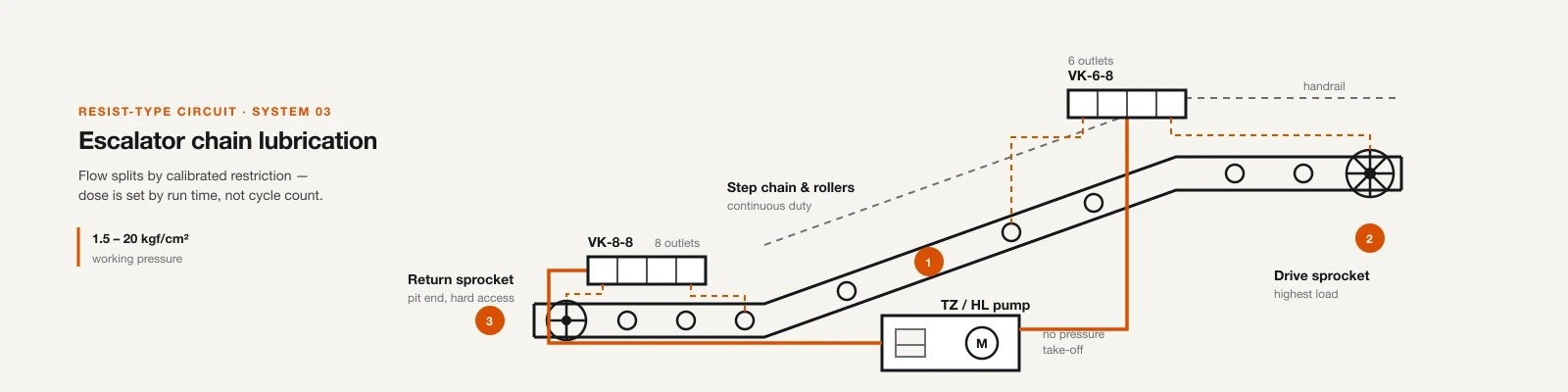
The lubrication circuit
Oil · System 03
Resist-type (proportional) system
Chains and sprockets run continuously rather than in cycles, so flow is proportioned for as long as the pump runs instead of metered per stroke.
Build
NKHY-8, TZ or HL pump + VK / VM, TCJ / TCZ or TK distributors
Dose
Proportional, set by restriction size
Pressure
1.5 – 20 kgf/cm²
No moving parts in the distributor. Each outlet carries a calibrated restriction, so oil splits between points in a fixed ratio for as long as the pump runs. Cheapest per point.
Where it runs
Escalators & conveyors
Chains, sprockets, step rollers: continuous duty, hard access
Core circuit products
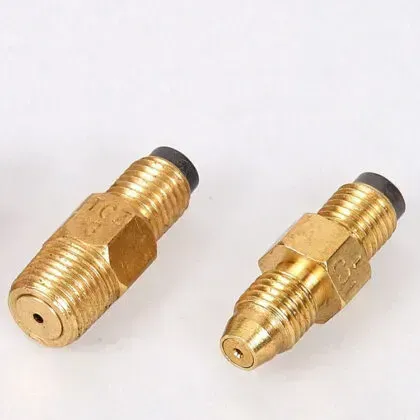
TCJ and TCZ restriction resist-type proportion distributors: five graded flow sizes, 1.5 – 20 kgf/cm², M8×1 inlet, each with a built-in filter screen.
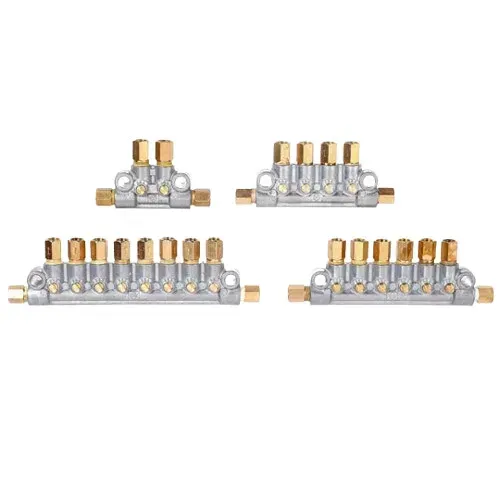
Manifold of calibrated restrictions splitting flow between 2 to 8 outlets in a fixed ratio, with no moving parts. Ø4 main and branch tube on M8×1.
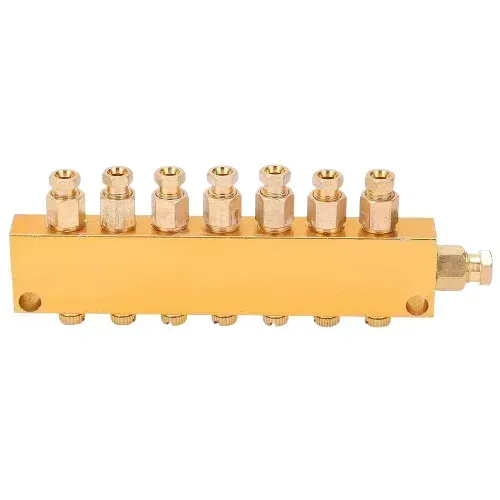
Two to ten outlets, each with an adjustable needle set on site, so the proportion between points can be tuned at commissioning and re-set later.
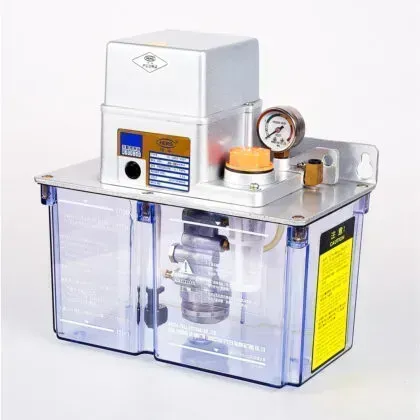
Motor-driven oil lubrication pump, 2 L or 4 L reservoir, 110 – 260 ml/min at 15 kgf/cm². Higher volumetric flow than the TZ, for circuits carrying more points.
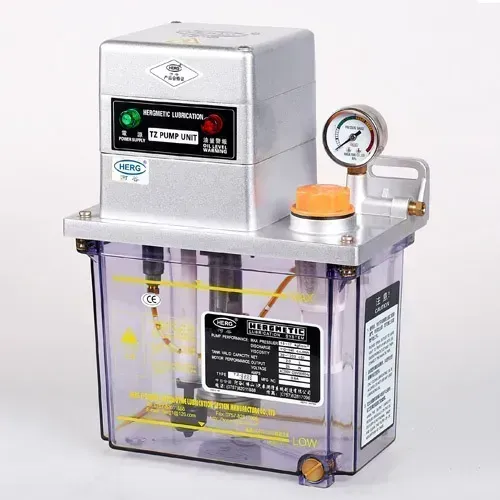
Motor-driven oil lubrication pump, 2L or 4L reservoir, 1.5 MPa rated, 110-260 ml/min. Timer, dual-timer and NK-3 variants for CNC and injection moulding.
Related reading
How volumetric, progressive, and resist-type distributors divide lubricant among points, and how each architecture behaves when a line blocks.
Sizing tells you what to buy; layout decides if you can maintain it. Pump placement, trunk and branch routing, and where distributors must sit.
Oil or semi-fluid grease on the clamp, why those points want pressure-volumetric metering, and the AMAG pump pairings that match a 35-type action window.
Frequently asked questions
Which lubrication circuit does an escalator run?
The resist-type (proportional) circuit. A TZ or HL pump feeds VK/VM manifolds, TCJ/TCZ in-line restrictors or TK adjustable blocks, and each outlet carries a calibrated restriction so oil splits between the points in a fixed ratio for as long as the pump runs. Working pressure is 1.5 – 20 kgf/cm². Dose per point is set by run time, not by cycle count.
Why not a volumetric circuit on a step chain?
A volumetric distributor meters a stated dose per cycle, which suits a machine that indexes. A step chain turns continuously, so what the points want is a steady proportioned feed rather than a shot per stroke. Resist-type is also the cheapest per point, which matters on a run carrying dozens of similar low-demand points. Where one point genuinely needs a stated volume, a DK single distributor covers it without changing the rest of the circuit.
Can the proportion be changed after commissioning?
Yes, and that is usually why TK is specified: two to ten outlets, each with an adjustable needle set on site and re-set later without changing parts. TCJ/TCZ restrictors take the other approach: the restrictor sits in the line at the point, in five flow grades from 1 to 16, so a point can be added or re-proportioned one fitting at a time. Record the settings on the machine before handover.
Does the pump need a pressure take-off mechanism?
No, and it must not have one driving a resist-type circuit. The take-off exists to cycle a volumetric distributor's piston; a resist-type block has no moving parts to cycle. Say which circuit you are building when you order, because the same TZ and HL pumps are supplied both ways.
Get a quote for your escalators & conveyors circuit
Tell us the machine and the number of lube points. We reply with a part list.