Technical Guides
How to Lubricate an Escalator or Conveyor Chain: A Resist-Type Circuit Explained
AMAG Team8 min read
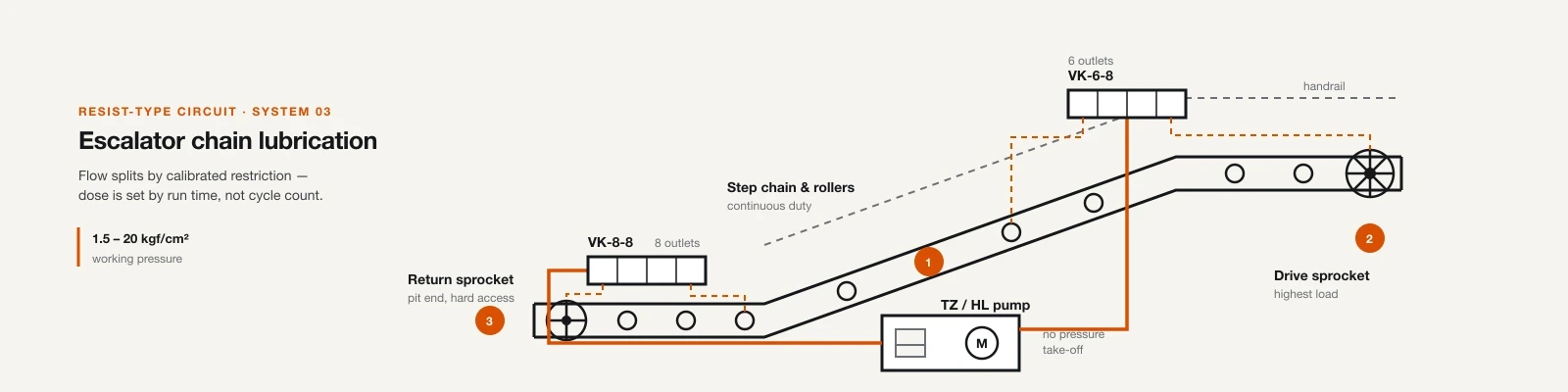
A machining centre lubricates in cycles. An escalator does not. The step chain, the drive sprocket and the return sprocket turn for as long as the unit is running, and the points sit inside a truss that nobody wants to open on a schedule. That combination, continuous duty and hard access, decides the lubrication circuit before any catalogue is opened.
The circuit AMAG supplies for this duty is resist-type: one oil pump, a few distributors that divide the flow in a fixed ratio, and no metering pistons anywhere in the line. This post explains why that fits a chain, what each distributor does differently, and how to avoid the two mistakes that cause most of the field problems: the wrong pump build and the wrong oil.
The industry page is lubrication systems for escalators and conveyors. What follows is the reasoning behind the pairings on that page.
What you are actually lubricating
The oil catalogue describes the application in one line: chains, sprockets and step rollers, continuous duty, hard access. In practice that is three families of point:
- The step chain, the long run that carries the load and articulates at every link.
- The drive and return sprockets, where the chain wraps and the pins and bushes take their highest articulation.
- Rollers, which turn at chain speed and see a small, steady demand each.
None of these wants a large shot of oil at a stated moment. They want a small, steady feed for as long as the chain moves. That is a different problem from the one a volumetric distributor solves.
Why resist-type, not volumetric
A volumetric block puts a metering chamber behind each outlet and fires a fixed dose each time the pump pressurises the line. That suits a machine that indexes: one stroke, one dose. A chain that never stops has no stroke to count.
A resist-type block does the opposite. Each outlet carries a calibrated restriction, and oil flows continuously while the pump runs. The restrictions divide that flow in a fixed ratio, so the dose a point receives is set by run time, not by cycle count. There is no piston, spring or valve to seize, which is a real advantage in a place you would rather not visit. It is also the lowest cost per point, which matters on a run with dozens of similar, low-demand points.
The honest cost is visibility. In a resist-type circuit a blocked point simply stops taking its share while flow continues elsewhere, and nothing signals it. The pump can tell you about pressure and oil level, but not about an individual point. Our architecture comparison covers that trade in full. For chains, the answer is a pump-side level and pressure signal plus a periodic look at the chain.
The three distributors
All three share the same circuit range, a system working pressure of 1.5–20 kgf/cm². They differ in where the proportion is fixed and who can change it.
| VK / VM | TCJ / TCZ | TK | |
|---|---|---|---|
| Form | Manifold of calibrated restrictions | In-line restrictor at the point | Manifold with an adjustable needle per outlet |
| Outlets | 2, 4, 6 or 8 | One restrictor per point | 2 to 10 |
| Proportion set by | Restriction fitted at manufacture | Flow grade fitted in the line: 1, 2, 4, 8 or 16 (relative flow) | Needle, set on site and re-set later |
| Tube | Ø4 main and branch, M8×1 | Inlet M8×1; outlet M8×1 (TCJ) or R1/8 (TCZ) | M10×1 main port for Ø6 tube |
| Moving parts | None | None; filter screen and single-side valve built in | Needle adjusters |
VK / VM is the default for a group of similar points. The VK comes in 2, 4, 6 and 8 outlets on hole centres from 34 to 118 mm. The VM-4-8 is the same four-outlet function on compact 21 mm centres for a mounting the 62 mm VK-4-8 will not fit.
TCJ / TCZ moves the restriction out of the manifold and into the line. That makes it the tool for trimming: add a point, or re-proportion one, by changing a single fitting. The grades follow a doubling series, 1, 2, 4, 8 and 16, so a point that needs eight times the flow of its neighbour takes grade 4 against grade 1. TCJ and TCZ share the same five grades; the letter only selects the outlet thread.
TK is the distributor to specify when nobody yet knows the right split: a new design, a re-tooled plant, a circuit whose demand will be learned at commissioning. The needle at each outlet is set on site, so the proportion can be corrected without changing any parts. The datasheet is blunt about the catch: adjustable means adjustable by someone who knows the target dose, so record the settings on the machine before handover.
The pump: same family, different build
A TZ or HL pump feeds all three. Both are alloy-steel gear pumps rated at 15 kgf/cm², with a maximum of 25 kgf/cm², delivering 110 to 260 ml/min depending on model and mains frequency, on a 2 L or 4 L reservoir. The HL is the higher-flow single-phase pump in the range; the TZ is also available three-phase. A level switch is standard and a pressure switch (5 or 10 kgf/cm²) is optional, so the pump can report both oil level and system pressure to the machine's control.
The build decides the circuit. With the pressure take-off mechanism, the pump cycles a volumetric distributor. Without it, the pump feeds resist-type distributors, delivering oil to each point in proportion. The take-off is not a field change, so say which one you want on the order. A pump built for volumetric duty on a resist-type circuit relieves the very pressure the restrictions rely on, and the block stops dividing the oil properly.
Where there is no electrical supply at the point, the NKHY-8 hand pump is the paired option for VK/VM, TK and TCJ/TCZ circuits.
The viscosity window that catches people out
This is where the published ranges matter. The TZ and HL pumps are rated for oil of 30 to 1000 cSt. The TCJ/TCZ restrictors are rated for 20 to 50 cSt. A pump feeding TCJ/TCZ therefore runs correctly only in the overlap: 30 to 50 cSt, at the temperature the oil actually reaches in service.
The reason is physical. A restriction passes oil according to its viscosity, so a heavier oil changes the proportion between points, and the ratios drift between cold and warm running. If the oil is thicker than the window, the points no longer get the split you set. The viscosity guide explains the numbers in more detail. Check the oil in the truss, not the one on the drum label at room temperature.
Setting how long it runs
Because dose is a function of run time, the timer on the pump is the dose control. The TZ is available with no timer, a built-in microcomputer timer, or the NK-3 digital display (action 1–999 s, interval 1–999 min), so action and intermittent period can be set freely. The same ideas as in setting intervals and doses on a total-loss system apply: start from the machine builder's lubrication schedule, then confirm at the chain, then record what you set.
We do not publish a universal run time for escalator chains here, because the right figure depends on the chain, the number of points and the manufacturer's specification. If you have the machine's schedule, we will size the circuit to it.
Commissioning checks
Run these before handover. A fuller version for any system is in the commissioning checklist.
- Pump build. Confirm the pump was ordered without the take-off.
- TCJ/TCZ direction. They are directional. Fit them with the arrow following the flow, or the single-side valve closes against you.
- Series. TZJ and TZZ resist-type distributors carry ten times the unit flow of TCJ and TCZ. Do not substitute one for the other, and check which series the machine was built with before replacing one.
- Oil. Confirm viscosity is inside 30–50 cSt where TCJ/TCZ is fitted.
- Settings. Write down every needle position and restrictor grade on the machine.
- Level and pressure signals. Wire them into the control so a low reservoir or a pressure fault is not discovered at the chain.
- Prime and watch. Run the pump and confirm oil reaches the far points, then check the chain for a visible film.
If a symptom appears later, troubleshooting a centralised lubrication system walks through it fault by fault.
When one point needs a stated volume
Resist-type is proportional, not metered. Where a single point genuinely needs a stated volume, a DK single distributor covers it without changing the rest of the circuit. Where the whole machine needs metered doses, specify RH-3 or 35 type volumetric distributors instead, with a pump that has the take-off fitted.
Next step
Describe the unit, the number of points and the oil in use on our system design worksheet and we will propose the pump build and the distributors, or start from the escalators and conveyors page.
Frequently asked questions
Can I fit a pump with a pressure take-off on a resist-type chain circuit?
No. The take-off exists to vent the line so a volumetric distributor's pistons can reset. A resist-type block has no pistons, and the take-off relieves the very pressure the restrictions need to hold, so the oil stops dividing the way it should. State "without take-off" when you order a TZ or HL pump for this circuit.
Why do my chain points get different amounts of oil when they share one manifold?
Because the split is set by the restriction fitted at each outlet, not by the point. A point with a more demanding chain run does not pull harder. If the proportions are wrong, change the restriction (a TCJ or TCZ grade at that point) or use a TK block and re-set the needle on site.
What oil viscosity should a TZ or HL pump feeding TCJ or TCZ restrictors run?
The pump is rated for 30 to 1000 cSt and the TCJ/TCZ restrictors for 20 to 50 cSt, so the oil has to sit in the overlap, 30 to 50 cSt, at the temperature the circuit actually runs. A heavier oil changes the proportion between points.
Related articles
Technical Guides
CNC Lubrication System Layout: Where the Pump, Lines and Distributors Go
Sizing tells you what to buy; layout decides if you can maintain it. Pump placement, trunk and branch routing, and where distributors must sit.
Technical Guides
When a Centralised Grease System Can Run NLGI 2
NLGI 2 belongs on a 30 MPa progressive circuit, not a GM or 35-type reservoir. The three grease pressure classes decide the grade, and what mixing them costs.
Technical Guides
How to Lubricate an Injection Moulding Machine: Tie Bars, Toggles, and Platens
Oil or semi-fluid grease on the clamp, why those points want pressure-volumetric metering, and the AMAG pump pairings that match a 35-type action window.